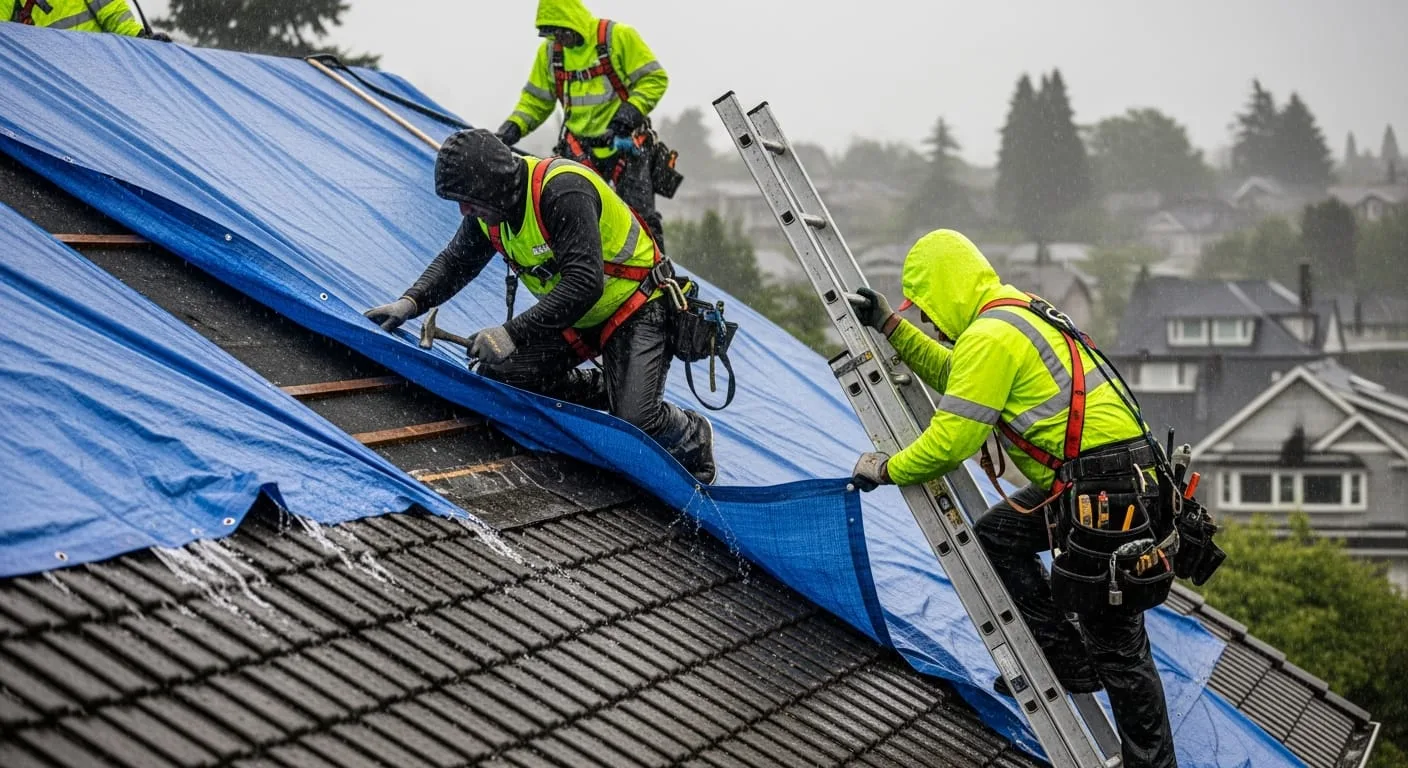
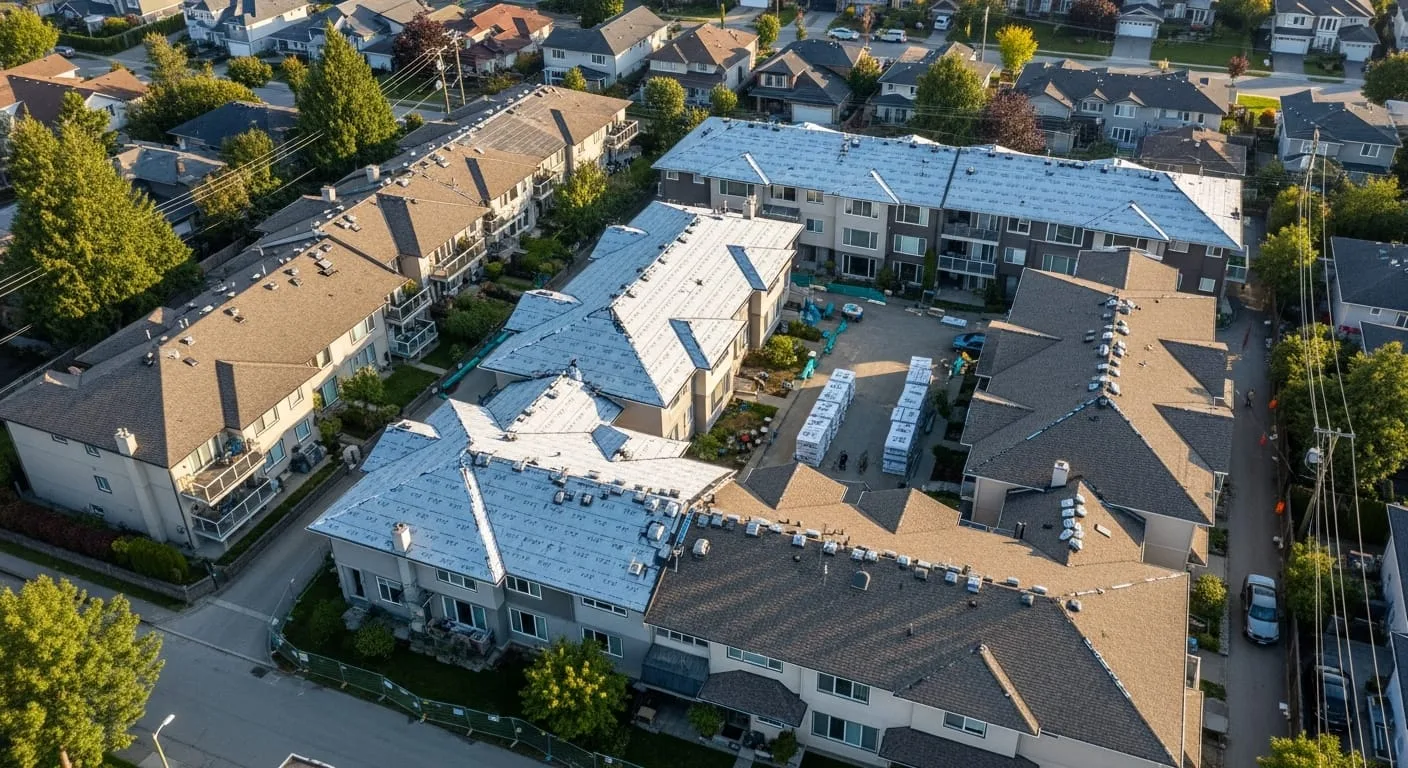
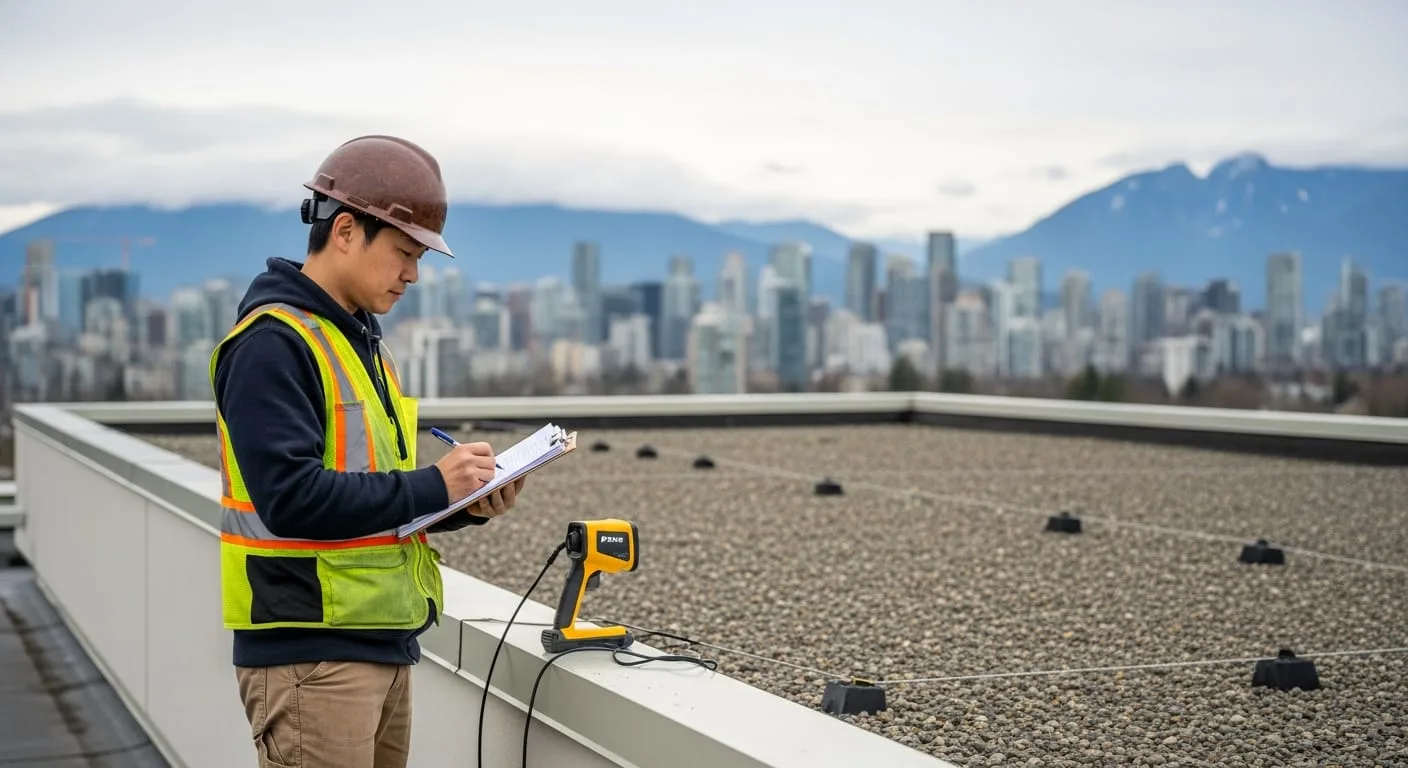
Multi-Family Licensed, Insured & Bonded Roofing
Published April 22, 2026 · Updated May 15, 2026

Multi-family roofing projects carry risks single-family work does not: shared common property, displaced residents, and seven-figure replacement costs. Licensing, insurance and bonding aren't paperwork — they're the council's only protection when something goes wrong.
Licensed
Every municipality in Metro Vancouver requires an active business license to perform roofing work. A roofer without one cannot legally pull a permit.
Insured
Minimum $2M general liability is industry standard. For multi-family we carry $5M, plus WorkSafeBC clearance so unpaid premiums never become a lien against your strata.
Bonded
A performance bond guarantees project completion even if the contractor defaults — critical on $500K+ townhouse re-roofs.
Commercial General Liability (CGL) Insurance: A Deeper Dive
Commercial General Liability (CGL) insurance is the absolute minimum requirement for any contractor working on strata property. It's designed to protect the contractor—and by extension, the strata corporation—from claims of bodily injury or property damage to third parties. For example, if a roofer's torch accidentally starts a fire that damages the building or a neighbouring property, their CGL policy would respond to cover the damages. If a piece of equipment falls and injures a resident or visitor, the policy covers medical expenses and potential lawsuits. Strata councils should insist on seeing a certificate of insurance with a substantial liability limit, often a minimum of $5 million for multi-family work, as roofing projects carry significant inherent risks.
The Critical 'Additional Insured' Endorsement
Simply verifying a contractor has insurance is not enough. The strata corporation must be named as an 'Additional Insured' on the contractor’s CGL policy for the specific duration of the project. This is a crucial endorsement that extends the contractor's insurance coverage to directly protect the strata corporation. If a lawsuit arises from the contractor's work, the strata corporation can claim defense and coverage directly under the contractor's policy, rather than its own. Without this, the strata's own insurance policy would be the first line of defense, leading to a potential claim on its record and an increase in future premiums. Always demand a certificate of insurance that explicitly names 'Strata Plan [Your #]' as an Additional Insured.
Understanding WorkSafeBC Coverage: More Than Just Worker Protection
In British Columbia, WorkSafeBC coverage is mandatory for most employers, including roofing contractors. This no-fault insurance system provides wage-loss benefits, medical coverage, and rehabilitation services to workers who are injured on the job. Critically for strata corporations, it also protects the property owner from being sued by an injured worker. If a contractor has active and adequate WorkSafeBC coverage, their employee cannot sue the strata corporation for an on-the-job injury. This 'liability shield' is a fundamental protection for the strata's finances and peace of mind.
The Dire Consequences of Hiring a Contractor Without Coverage
If a strata hires a contractor who fails to maintain their WorkSafeBC coverage (or is not registered), the strata corporation can be deemed the 'employer' of the injured worker. This means the strata could be held directly responsible for all costs associated with the worker's injury, including wage-loss payments and medical bills, which can easily run into hundreds of thousands of dollars. Furthermore, WorkSafeBC can levy significant fines and penalties against the strata for hiring an unregistered contractor. Verifying active coverage is not optional; it's an essential risk management step.
How to Verify a WorkSafeBC Clearance Letter
A contractor should provide a WorkSafeBC Clearance Letter before starting work. This letter confirms that their account is in good standing and all premiums have been paid. It is crucial to verify this letter's authenticity. Strata councils or managers can do this easily and instantly online through WorkSafeBC's website by simply entering the contractor's account number. The clearance letter has a specific validity period, so it's important to get an updated one just before the project commences. Do not rely on a letter that is weeks or months old, as the contractor's status could have changed.
The World of Surety Bonds: A Three-Party Guarantee
Unlike insurance, which is a two-party agreement to cover losses, a surety bond is a three-party guarantee. The three parties are the Principal (the contractor), the Obligee (the strata corporation), and the Surety (the bonding company). The bond guarantees that the contractor will fulfill their obligations. If the contractor fails to do so, the surety company steps in to protect the strata corporation from financial loss. Obtaining a bond is a rigorous process for a contractor; they must prove their financial stability, experience, and capacity to the surety company. As such, a bonded contractor is already pre-vetted and represents a lower risk.
Performance Bonds and Labour & Material Payment Bonds
For major projects, two types of bonds are key. A Performance Bond guarantees that the contractor will complete the project according to the terms of the contract. If the contractor defaults or goes bankrupt mid-project, the surety company will step in to find another contractor to finish the job or compensate the strata for the financial loss. A Labour & Material Payment Bond guarantees that the contractor will pay all their workers, subcontractors, and suppliers. This protects the strata corporation against Builders' Liens being filed against the property by unpaid parties. For large-scale roof replacements, requiring both types of bonds is a prudent form of project security.
How to Read a Certificate of Insurance (COI)
A Certificate of Insurance (COI) is a snapshot of a contractor's coverage at a specific point in time. When reviewing a COI, a strata council should look for several key details. Don't just glance at it; verify the information. Ensure the contractor's legal name on the certificate matches the name on your contract. Check the policy effective and expiry dates to ensure coverage is active for your entire project timeline. A professional roofing contractor will have no issue providing a clear, current COI upon request.
- Producer: The name of the insurance broker who issued the certificate.
- Insured: The legal name of the contractor. This must match your contract.
- Policy Numbers & Dates: Verify the policy numbers and ensure the expiry date is after your project's completion date.
- Types of Insurance & Limits: Look for Commercial General Liability and confirm the limit (e.g., $5,000,000). Check for any other relevant policies like Automobile Liability.
- Description of Operations / Additional Insured: This is the most important section. It must explicitly state that 'Strata Plan [Your #] is included as an Additional Insured' with respect to the project. If this wording is missing, the certificate is inadequate.
Identifying Common Gaps and Exclusions in Coverage
Not all insurance policies are created equal. Sometimes, what a policy *excludes* is more important than what it includes. Strata councils should be aware of common exclusions that can leave them exposed. For roofing, a critical one to watch for is a 'hot work' or 'torch-on' exclusion. If a contractor's policy has this, and they are installing an SBS torch-on roof, they have no coverage for a fire caused by their torching activities. Another common issue is subcontractor exclusions. If the policy doesn't cover the work of subcontractors, and the primary contractor subs out the work, the strata could be left unprotected. It's wise to have your strata's insurance broker review the contractor's COI for any such red flags.
Unique Liability Profiles: Townhouse Complexes vs. Apartment Buildings
While all multi-family properties need properly insured contractors, the risk profile can differ. Townhouse complexes often have more ground-level interaction with residents, extensive landscaping, and multiple, separate roof structures. This increases the potential for trip-and-fall incidents, damage to private patios or gardens, and logistical challenges with materials and access. High-rise apartment buildings, on the other hand, present risks related to falling objects from height, securing materials and equipment against high winds, and managing access through a single lobby or elevator bank. The contractor's safety plan and insurance coverage must be adequate for the specific type of building and its unique set of risks.
Frequently Asked Questions
- What does 'bonded' actually mean?
- A surety company guarantees the contractor's performance. If they default, the bond pays to finish the job.
- Do you carry WorkSafeBC clearance?
- Yes — current clearance letter provided with every bid.
- What is the difference between being 'insured' and 'bonded'?
- Insurance is a two-party contract that protects the contractor from specified losses (like property damage or injury), which indirectly protects you. A bond is a three-party guarantee that protects the strata corporation (the 'obligee') directly. If the contractor (the 'principal') fails to perform their contract or pay their bills, the surety company steps in to make the strata whole. A bond guarantees performance, while insurance covers accidental loss.
- Our strata manager says they vet contractors. Do we still need to be involved?
- Yes. While a good strata manager is an invaluable partner in vetting contractors, the ultimate legal and financial responsibility rests with the strata council as the elected representatives of the owners. The council should understand the vetting process, review the key documents (like the COI and clearance letter) themselves, and be part of the final decision-making process. Think of it as 'trust, but verify.' This shared responsibility ensures comprehensive due diligence.
- Can a contractor's insurance lapse in the middle of our roofing project?
- Absolutely. A certificate of insurance is a snapshot in time. A contractor could cancel their policy or fail to make a premium payment the day after they provide you with the certificate. This is why the COI should include a 'notice of cancellation' clause, obligating the insurer to attempt to notify you if the policy is cancelled. It's also prudent to request an updated COI at key project milestones for long-term projects.
- Who is responsible if an uninsured subcontractor gets injured on our property?
- This creates a very dangerous situation. If your general contractor hires an uninsured subcontractor who then gets injured, liability can travel 'up the chain.' WorkSafeBC or the courts could find the general contractor and potentially the strata corporation liable for the injury costs. This is why your contract must stipulate that the general contractor is responsible for ensuring all of their subcontractors are also fully insured and in good standing with WorkSafeBC.
- How can we be sure a surety bond is real and valid?
- A valid bond certificate will be issued by a licensed surety company and will include the bond number, the names of the principal (contractor) and obligee (strata), and the project details. The most direct way to verify a bond is to contact the surety company listed on the document directly. Their contact information should be on the bond, or you can look them up online. Ask them to confirm the validity of the bond number for the specific contractor and project.
Need a free assessment?
Licensed · Insured · Bonded roofing across Metro Vancouver.