Flat Roof Replacement Cost in Vancouver BC: 2026 Pricing Guide
Published May 16, 2026 · Updated May 17, 2026
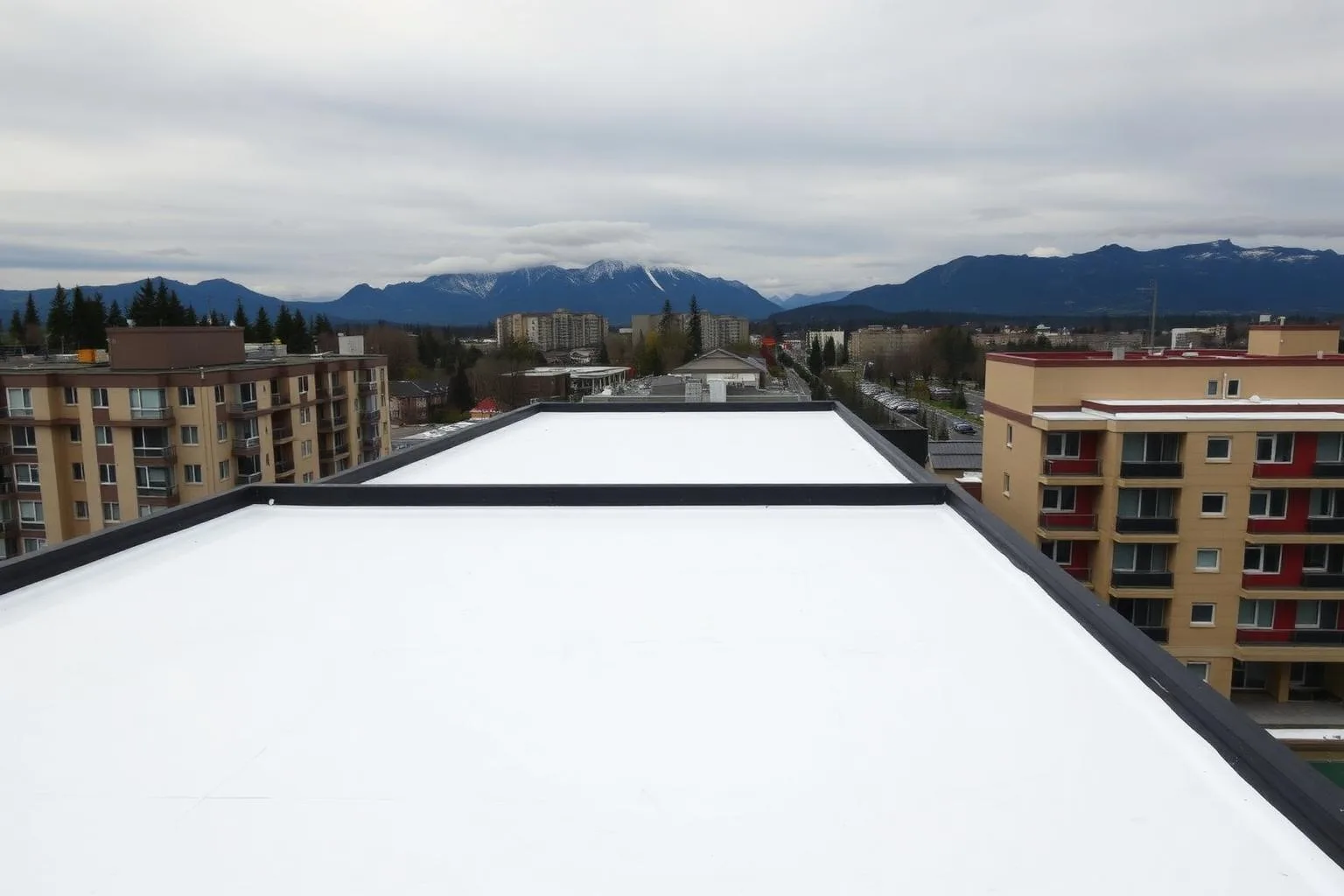
Flat roof replacement is the single largest building-envelope expense most Vancouver strata councils, multi-family owners, and small commercial property owners will face. In 2026, prices have stabilized after three years of pandemic-era volatility, but they remain materially higher than pre-2020 baselines. This guide breaks down exactly what you should budget per square foot in Metro Vancouver, what drives the variation, and the line items that most contractors leave out of their first conversation.
2026 Flat Roof Replacement Cost — Vancouver Quick Reference
Across the Lower Mainland — Vancouver, Burnaby, Surrey, Richmond, Coquitlam, Langley and the North Shore — current installed pricing for flat roof replacement on a typical 10,000 sq ft strata or commercial building falls into the following bands. All figures are CAD per square foot, fully installed, including tear-off, two-layer modified bituminous or single-ply membrane, base sheet, fasteners, flashings, parapet wraps, and standard disposal.
- SBS modified bitumen, 2-ply torch-on: $14–$22 per sq ft
- TPO single-ply mechanically attached, 60-mil: $13–$19 per sq ft
- PVC single-ply, 60-mil: $16–$23 per sq ft
- EPDM rubber, 60-mil fully adhered: $12–$18 per sq ft
- Inverted (IRMA) protected membrane assembly: $22–$34 per sq ft
On a 10,000 sq ft footprint that translates to roughly $130,000 to $230,000 for a mainstream torch-on replacement, or $220,000 to $340,000 for a high-end inverted assembly engineered for a green roof or amenity deck. Smaller projects under 3,000 sq ft pay a premium of 15–25% because mobilization, crane, and disposal fees are spread across less area.
What Actually Drives the Price
1. Tear-off complexity and existing layers
BC building code allows a maximum of two roof layers on a structure. If your building already has two — common on buildings from the 1980s and 1990s that received a recover in the 2000s — full tear-off down to the deck is mandatory. Tear-off and disposal alone runs $2.50–$4.50 per square foot in Metro Vancouver, and the larger the existing assembly, the more truck loads to Metro Vancouver Regional District transfer stations at current tipping fees of $135–$165 per tonne.
2. Deck condition and structural repairs
Roughly 20–30% of strata re-roofs in BC uncover deteriorated plywood or OSB sheathing once the membrane is removed. Budget a contingency of $3,000–$8,000 for sheathing replacement on a typical 10,000 sq ft project. On older concrete decks, look for rebar exposure and spalling that may require structural engineering review before re-roofing.
3. Insulation upgrades and BC Energy Step Code
BC has progressively tightened thermal envelope requirements under the BC Energy Step Code. Any permitted re-roof in most Metro Vancouver municipalities now requires upgrading to a minimum R-30 to R-40 effective. Polyisocyanurate insulation adds $4–$7 per square foot but typically pays back within 8–12 years in reduced HVAC load and qualifies for BC Hydro and FortisBC rebates of $0.50–$1.50 per square foot.
4. Membrane choice — performance vs. budget
SBS torch-on remains the workhorse of Vancouver strata roofing because it handles the wet-dry-freeze cycle of our coastal climate, accepts foot traffic for mechanical service, and carries 20-year RCABC Guarantee coverage. TPO has gained share on newer concrete towers due to its reflectivity and lighter weight. PVC commands a premium where chemical resistance matters — restaurants, hospitals, food processing. EPDM is the budget option but underperforms in UV and is rarely specified for Class-A multi-family in BC anymore.
5. Access, height, and crane requirements
Anything above three stories typically requires a crane day at $2,200–$3,800 per day, plus boom truck mobilization. Tight downtown Vancouver sites with no laydown area can add $0.75–$1.50 per square foot in handling costs. Buildings backing onto SkyTrain or BC Hydro lines require BC Hydro standby — another $1,800–$2,400 per day.
Hidden Costs Most Bids Don't Include
When you compare bids, look specifically for these line items. Their absence is the most common reason a 'low' bid becomes the highest final invoice:
- Permit fees — $1,200–$3,500 depending on municipality and project value
- BC Hydro standby for overhead lines — quoted per day
- Asbestos testing on pre-1990 buildings — mandatory, $1,500–$3,000
- Drain replacement and overflow scupper retrofits to current code
- Skylight curbs, hatch curbs, and HVAC curb flashings
- Solar-ready conduit if your strata is planning a future PV system
- Lightning protection re-bonding on tall buildings
- Engineered tie-back anchors for future window-washing or maintenance access
Strata-Specific Budgeting Considerations
Strata corporations in BC are required under the Strata Property Act to fund roof replacement through the Contingency Reserve Fund based on the most recent depreciation report. If your report is more than three years old, the cost estimate it carries is likely 25–40% too low for 2026 conditions. We recommend commissioning an updated reserve study before going to AGM with a special levy proposal, and budgeting an additional 10% contingency above the highest qualified bid.
When presenting to ownership, frame the cost in dollars per unit per month over the bond amortization period, not the total sticker price. A $1.8M re-roof on a 60-unit building amortized over 15 years is roughly $167 per unit per month — far easier to approve than a $30,000 special levy.
How to Use This Guide
Use these numbers as a sanity check, not a quote. Get three qualified bids from RCABC-member contractors, demand line-item itemization, and require written membrane manufacturer specifications. If you'd like a no-obligation assessment for your Metro Vancouver building, call us at 604-446-3482 or email admin@budgetroofers.ca.
Frequently Asked Questions
- What is the average cost of flat roof replacement in Vancouver?
- In 2026, a typical SBS torch-on flat roof replacement in Metro Vancouver runs $14–$22 per square foot installed, including tear-off, two-ply membrane, flashings, and standard disposal. Budget $130,000–$230,000 for a 10,000 sq ft project.
- Is SBS or TPO better for Vancouver's climate?
- SBS torch-on outperforms TPO for the wet-dry-freeze cycle typical of Metro Vancouver, handles foot traffic better, and qualifies for the 20-year RCABC Guarantee. TPO is competitive on new concrete towers where reflectivity and weight matter more than puncture resistance.
- Do I need a permit to replace a flat roof in Vancouver?
- Yes. Every municipality in Metro Vancouver requires a roofing permit for full replacement. Permit fees range from $1,200 to $3,500 depending on project value, and BC Energy Step Code now mandates an insulation upgrade on most re-roof permits.
- How long does a flat roof replacement take?
- A typical 10,000 sq ft strata flat roof takes 7–14 working days, weather permitting. Pacific Northwest rain delays can extend that by 3–5 days during October–March.
- What is the lifespan of a new flat roof in BC?
- A properly installed SBS torch-on roof with annual maintenance lasts 25–30 years in BC's coastal climate. PVC and TPO typically deliver 20–25 years; EPDM 15–20 years.
- Are there rebates available for flat roof replacement in BC?
- Yes. BC Hydro and FortisBC offer $0.50–$1.50 per square foot in rebates for qualifying insulation upgrades performed during a re-roof. CleanBC Better Buildings program also covers commercial buildings.
Need a free assessment?
Licensed · Insured · Bonded roofing across Metro Vancouver.