Roof Sections of the BC Depreciation Report: A Council's Guide
Published May 17, 2026 · Updated May 17, 2026
Under section 94 of the BC Strata Property Act, every strata corporation of five or more units is required to obtain a depreciation report and update it every five years unless owners pass a three-quarter vote to defer. The single largest line item in that report — for almost every strata in the province — is the roof. Get the roof section right, and your Contingency Reserve Fund (CRF) builds steadily and predictably toward replacement. Get it wrong, and your owners face surprise special levies running into the millions. This guide explains how to read the roof section, when to update it, and what 2026 numbers actually hold up against the bids you will eventually receive.
What the Roof Section of a Depreciation Report Contains
A properly prepared roof section in a BC depreciation report contains seven specific data points for each distinct roof area on the building. If your report is missing any of these, it is incomplete and should be reissued before the council relies on it for CRF planning.
- Assembly description — membrane type, layers, insulation, deck
- Total area in square feet for each distinct roof or roof area
- Year of original installation or last full replacement
- Estimated remaining useful life (RUL) in years
- Estimated current replacement cost, in current dollars
- Inflation factor used to project future cost at replacement date
- Funded amount in current CRF and recommended annual contribution
How the Roof Drives the Contingency Reserve Fund
The depreciation report's job is to smooth the financial impact of major component replacement across the building's full life cycle. The roof is the largest, longest-cycle, and most expensive component on most strata buildings, so its assumptions drive the bulk of the CRF contribution schedule.
If the report assumes a roof costs $1.8M today and inflates that to $2.6M in 12 years at the projected replacement date, the recommended annual CRF contribution backs out from that future number, divided by years to replacement, less the current CRF balance. A 25% error on the roof cost — easily possible on a report more than three or four years old — translates directly to a 25% under-funded CRF and a special levy when the bids come in.
Why 2026 Reports Should Be Updated Even If You Are Not Due Yet
Roof replacement costs in BC rose roughly 38–52% between 2020 and 2025 depending on assembly type. If your last depreciation report was issued in 2021 or earlier, the roof cost is materially understated regardless of the inflation factor the consultant used. The Strata Property Act allows a three-quarter vote to defer the update, but it does not protect the council from owner complaint or fiduciary criticism if a known under-statement was not addressed.
Best practice in 2026 is to commission an interim roof-only cost update from a qualified roofing consultant or RCABC member contractor, attach it to the depreciation report as an addendum, and adjust the CRF contribution accordingly. This is a fraction of the cost of a full report and protects the council.
Remaining Useful Life — The Number Most Often Wrong
Remaining useful life (RUL) is the single most disputed number in any roof section. A consultant working from a desktop review of original construction documents will typically assign the manufacturer's design life — 25 years on torch-on, 20 on TPO, 18 on shingle. A consultant who actually walks the roof with a moisture meter, inspects parapets and penetrations, and reviews maintenance records will assign a real RUL that may be 5–10 years different in either direction.
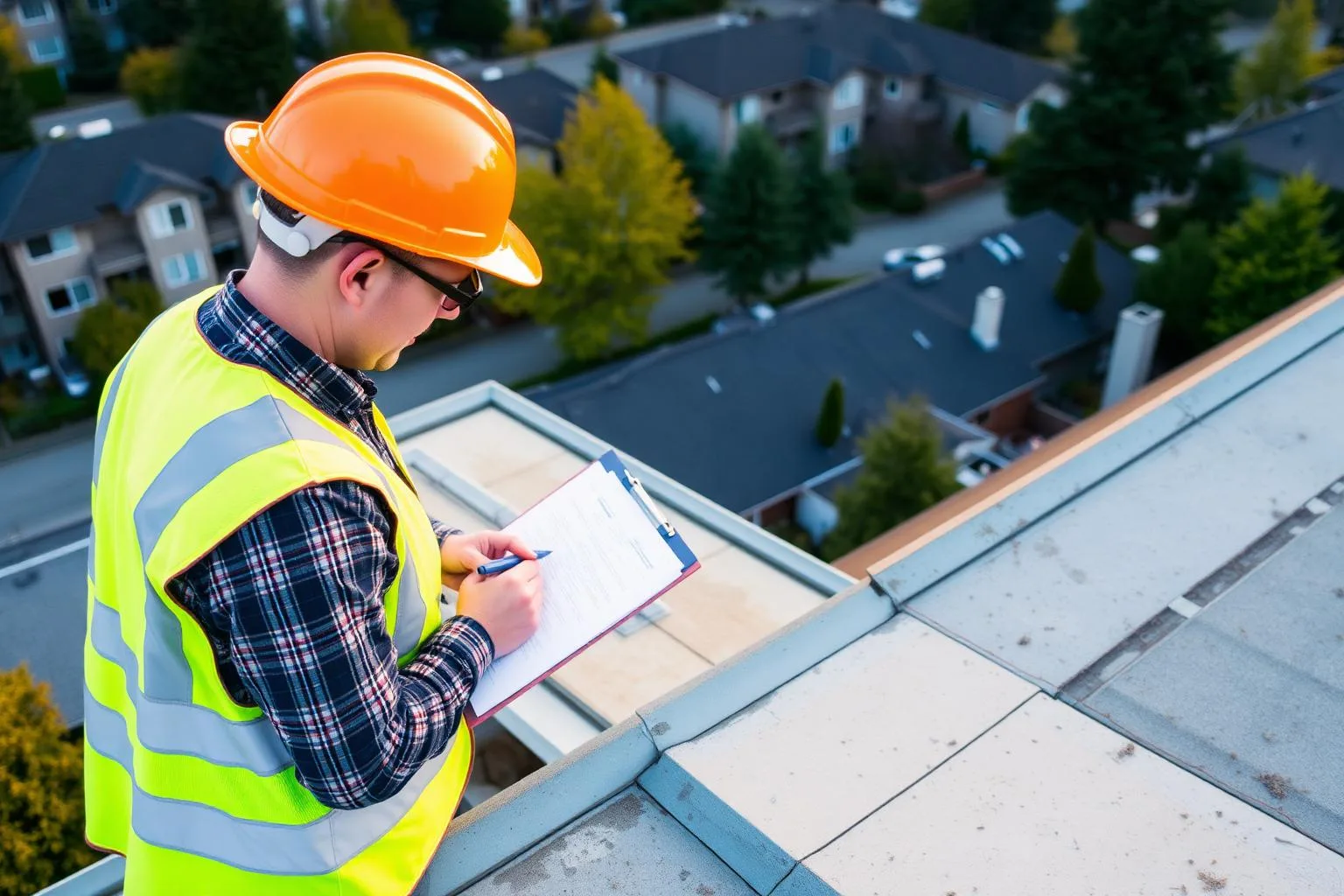
Ask whether your depreciation report consultant physically accessed the roof, and request their inspection notes. If the answer is no, get the roof RUL re-assessed by an RCABC member contractor and update the report addendum.
Inflation Factor: Be Conservative
Most BC depreciation reports use a 2.5% to 3.5% annual inflation factor on construction costs. Actual construction-cost inflation in BC has averaged 5.8% since 2018, with several years above 8%. Conservative councils now request a 5% inflation factor for the next 5-year planning horizon, with a fallback to 3.5% beyond year five. This reduces the chance of an underfunded CRF when bids come in.
Funding Models — Strong, Adequate, and Cash-Flow
Depreciation reports typically present three funding models: strong (CRF reaches 70%+ of fully-funded), adequate (40–70%), and cash-flow (special levies as needed). Cash-flow funding shifts the entire cost of a roof replacement onto whoever owns the unit the year it is replaced — typically a $20,000–$45,000 levy that can derail a sale or refinance. Adequate funding spreads most of the cost across years but still requires modest top-up levies. Strong funding effectively eliminates surprise levies.
For long-term owner equity protection, councils should target the adequate or strong model. Make this an explicit decision at AGM rather than defaulting to whatever the consultant put first in the report.
How to Cross-Check Your Roof Section Against Reality
- Request a no-obligation budget letter from two RCABC member contractors based on your actual roof area and assembly
- Compare the average of those two budgets to the depreciation report's current replacement cost
- If they diverge by more than 10%, ask the consultant to reissue the roof section
- Compare the report's assumed RUL to the contractor's on-roof assessment — adjust if they disagree by more than three years
- Confirm the inflation factor is at least 5% for the first five years of projection
When the Numbers Justify Action Now
If your updated roof section shows replacement within 5 years and your CRF is funded at less than 50% of the projected cost, the council has a fiduciary obligation to bring a funding plan to owners at the next AGM. Options include increased monthly CRF contributions, a planned special levy schedule, or financing through a strata loan. Acting two AGMs early typically costs each owner about half of what a last-minute emergency levy costs.
Get a Roof Budget Letter for Your Report
Strata Roofers BC provides no-obligation budget letters for BC depreciation report consultants and councils. We measure the roof, confirm the assembly, and issue a written 2026 replacement-cost estimate suitable for direct inclusion in the report. Call 604-446-3482 or email admin@budgetroofers.ca.
Frequently Asked Questions
- How often does the BC Strata Property Act require a depreciation report update?
- Every five years, unless owners pass a three-quarter vote to defer. Even when legally deferred, councils should update the roof section by addendum if construction costs have moved materially — which they have since 2020.
- What is the difference between a depreciation report and a roof inspection report?
- A depreciation report covers all major building components and projects the Contingency Reserve Fund out 30 years. A roof inspection report focuses solely on the current condition, defects, and remaining useful life of the roof assembly. Most strong reports incorporate a recent roof inspection as an attachment.
- Who should perform the roof inspection that feeds the depreciation report?
- Ideally an RCABC member contractor or a qualified roofing consultant who physically accesses the roof, takes moisture readings, and reviews maintenance history. A desktop review from construction documents is not sufficient for a defensible report.
- What inflation factor should our depreciation report use for the roof?
- We recommend at least 5% per year for the first five years, then 3.5% thereafter. BC construction-cost inflation has averaged 5.8% since 2018, well above the 2.5–3% many older reports assume.
- Can we avoid a special levy if our CRF is underfunded?
- Sometimes — through a strata loan, a planned multi-year CRF top-up, or staged replacement of distinct roof areas. The earlier the council acts on a known shortfall, the more options remain available.
- Does Strata Roofers BC provide budget letters for depreciation reports?
- Yes — we provide no-obligation written 2026 replacement-cost estimates suitable for direct inclusion in depreciation reports. Contact us at 604-446-3482 or admin@budgetroofers.ca.
Need a free assessment?
Licensed · Insured · Bonded roofing across Metro Vancouver.