Strata Roof Replacement in Brentwood, Burnaby: 2026 Cost and Workflow Guide
Published June 5, 2026 · Updated June 16, 2026
Brentwood and Metrotown have transformed faster than any other neighbourhood in Metro Vancouver over the past decade, and the strata roof replacement market has transformed with them. The catchment now spans original 1980s and 1990s wood-frame low-rise condos along Willingdon and Kingsway, mid-rise concrete buildings from the 2000s along Lougheed and Hastings, and the first generation of 1990s glass-and-concrete high-rises that are now reaching the end of their original roof membrane service life. This guide is written for strata councils in Brentwood, Metrotown, Edmonds and Highgate facing a 2026 re-roof decision on any of those building types.
The Three Burnaby Roof Replacement Markets
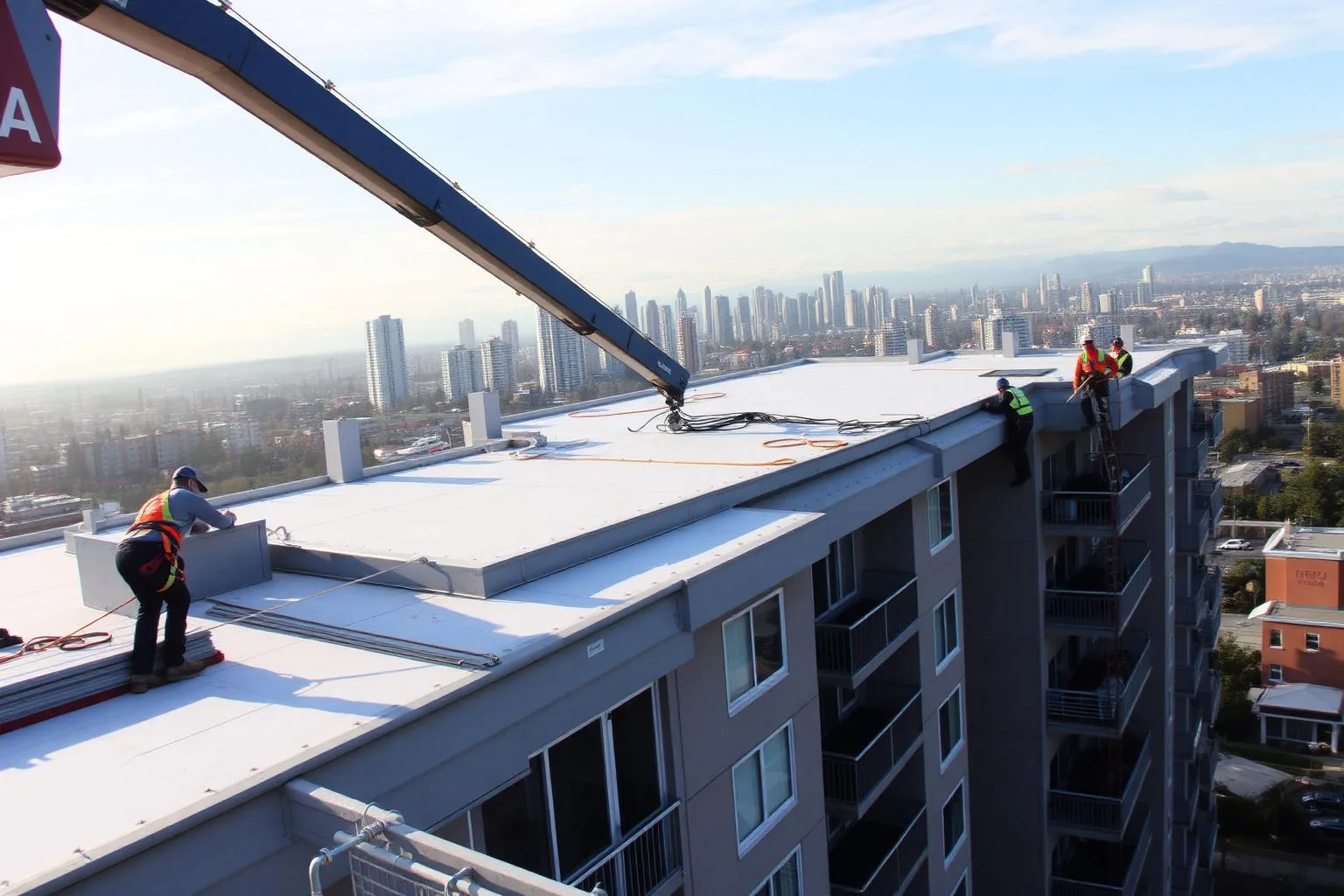
Burnaby strata roofs in 2026 fall into three operationally distinct markets. The first is wood-frame low-rise re-roofs, mechanically similar to Kitsilano or East Vancouver work but with cheaper street access and easier parking permits. The second is mid-rise concrete-building membrane replacement, typically 8 to 12 storeys, where crane logistics dominate the schedule. The third is true high-rise roof replacement, 20 storeys and up, where the work is closer to commercial construction than to residential roofing and requires a contractor with specific high-rise membrane experience and the engineering documentation to back it up.
Most strata councils in Brentwood and Metrotown assume their building falls into the low-rise market because that is what they hear about from neighbours and on social media. In practice, anything above 6 storeys requires a fundamentally different bid pool, a different permit workflow with the City of Burnaby, and a different set of insurance and bonding requirements. Mis-categorizing your building at the bid stage produces bids from contractors who cannot actually do the work safely.
Realistic 2026 Cost Ranges for Brentwood and Metrotown
Burnaby costs in 2026 are running close to the Lower Mainland average for low-rise work and 15 to 25 percent above average for mid-rise and high-rise work, driven by crane rental, traffic-control flagging, and tighter safety regimes. Per-square-foot installed costs for typical Burnaby strata assemblies in 2026:
- Wood-frame low-rise asphalt re-roof: $10.50 to $13.50 per square foot of roof area
- Low-rise SBS two-ply torch-on membrane: $17.00 to $22.00 per square foot
- Mid-rise TPO single-ply with crane access: $19.00 to $26.00 per square foot
- Mid-rise PVC single-ply with parapet rebuild: $22.00 to $30.00 per square foot
- High-rise modified bitumen replacement with engineered fall-protection: $26.00 to $36.00 per square foot
A typical 12-storey Brentwood concrete strata building with roughly 12,000 square feet of usable roof area should therefore budget between approximately $230,000 and $310,000 for a TPO single-ply replacement, before engineering, permits and contingency. Councils whose depreciation reports were written before the 2023 cost inflation should expect the original allowance to be 20 to 35 percent low and should rebuild the reserve plan accordingly before committing.
City of Burnaby Permits and Engineering Requirements
Burnaby requires a building permit for any roof replacement on a stratified building above 3 storeys, and for any low-rise replacement that changes the roof assembly, adds skylights or modifies ventilation. The application requires a sealed letter from a BC-registered structural engineer confirming the existing structure can carry the new assembly, manufacturer documentation, a waste-management plan, and a WorkSafeBC notice of project for the construction phase.
Burnaby permit review typically runs 4 to 8 weeks for a residential strata, faster than Vancouver but slower than the smaller Tri-Cities municipalities. The City has been actively enforcing fall-protection requirements on mid-rise and high-rise roof work since 2024, and applications that do not include a complete engineered fall-protection plan are now routinely sent back at first review.
Crane Logistics on Lougheed, Willingdon and Kingsway
Crane access is the single largest operational constraint on every mid-rise and high-rise Burnaby strata re-roof. Available crane positions on most Brentwood and Metrotown sites are limited by SkyTrain guideway proximity, overhead BC Hydro lines, adjacent tower setbacks, and the City's traffic-control requirements on Lougheed, Willingdon, Kingsway and Hastings. The contractor's project manager should walk the site with the crane operator at least 60 days before mobilization and submit a traffic-control plan to the City as part of the permit package, not as an afterthought.
Where street closures are required, schedule them for weekends and statutory holidays to minimize impact on commuter traffic. Burnaby will issue weekend closure permits but they are expensive and have to be booked at least 30 days in advance. The cost should sit on the contractor's line item, not on a change order against the strata after the fact.
Membrane Selection: TPO vs PVC vs SBS in Burnaby's Climate
For Burnaby mid-rise and high-rise flat roofs in 2026, three membrane families dominate the market. TPO single-ply offers the lowest installed cost, fast install, and a reasonable 20- to 25-year service life when correctly detailed. PVC single-ply is more chemically resistant and a better choice on buildings with rooftop HVAC discharge, restaurant exhaust nearby, or proximity to industrial pollution sources along the Burnaby waterfront. SBS two-ply torch-on remains the most durable option but is heavier, slower to install, and increasingly difficult to find experienced installers for as the labour market shifts toward single-ply.
For a typical Brentwood concrete mid-rise with rooftop heat pumps and no unusual chemical exposure, TPO is usually the right answer. For Metrotown high-rises with adjacent commercial kitchens or pre-2015 buildings with original 2-ply assemblies, PVC or SBS may still be the better long-term choice. The decision should be made with the membrane manufacturer's technical rep on the call, not from a generic spec sheet.
Owner Communication in a High-Rise Strata
Communication in a 200-unit high-rise is operationally different from a 20-unit townhouse. Owners do not see the work, do not hear most of it, but are acutely sensitive to elevator usage by the contractor, lobby protection, and any disruption to amenity rooftops or terraces. The council should require the contractor to publish a weekly written update by Friday evening covering the prior week's progress, the coming week's plan, any elevator reservations, and any rooftop amenity closures.
The strata's property manager should coordinate a single rooftop amenity closure plan in advance with affected owners rather than handling each closure ad hoc. On most Brentwood high-rises this means a 6 to 10 week full closure of rooftop amenity space, communicated 8 weeks in advance with a clear reopening date and a refund or credit policy for owners with paid amenity bookings.
Sequencing Around SkyTrain and BC Hydro
Many Brentwood and Metrotown strata buildings sit within 20 metres of the SkyTrain Millennium or Expo Line guideway or within the BC Hydro overhead transmission corridor. Any crane work or scaffold erection within those setbacks requires advance approval and, in the case of BC Hydro, often requires a temporary line outage scheduled 8 to 16 weeks in advance. Councils whose contractor has not flagged these constraints by the contract-signing stage should ask directly before mobilization begins.
Depreciation Report Alignment for Burnaby Strata
Most Burnaby strata corporations had depreciation reports prepared between 2014 and 2019 under the original Strata Property Act requirements, and those reports almost universally underestimate 2026 roof replacement costs by 20 to 40 percent for mid-rise and high-rise buildings. Councils relying on the original report's allowance to size the special levy or contingency reserve are routinely surprised at the contract-signing stage. Before issuing the SGM notice, commission an updated cost projection from the contractor or from the depreciation report consultant — the $1,500 to $3,500 update fee is the cheapest insurance available against a failed SGM vote.
Where the updated cost exceeds the depreciation report allowance by more than 25 percent, the council should consider a two-phase funding approach: an immediate special levy for the gap plus a contingency reserve top-up over 2 to 3 years. Trying to fund the entire delta through a single special levy on short notice produces owner pushback that delays the project past the construction window.
Insurance and Bonding on Burnaby Mid-Rise and High-Rise Projects
Insurance requirements scale sharply with building height in Burnaby. For low-rise wood-frame projects, $5 million general liability is the standard council expectation. For mid-rise concrete buildings, $5 million should be considered the floor and $10 million is increasingly the expectation from sophisticated property managers. For true high-rise projects above 12 storeys, $10 million general liability plus a performance bond on the full contract value is standard, and councils should require certificates from the contractor's primary insurer rather than from a broker.
WorkSafeBC fall-protection exposure on Burnaby high-rise projects is the single largest risk concentration in the entire project, and a contractor whose WorkSafeBC clearance letter has any current outstanding orders or recent fatalities in their incident history should be disqualified from the bid pool. Property managers should request the contractor's full WorkSafeBC employer summary, not just the clearance letter, before recommending a bid to council.
What a Realistic Brentwood Re-Roof Timeline Looks Like
A typical Brentwood or Metrotown mid-rise re-roof in 2026 runs 10 to 14 months from first scoping call to project close. The front-end phases — scoping, bid solicitation, engineering, council review and SGM vote — typically run 4 to 6 months for a high-rise versus 2 to 3 months for a low-rise. Permitting and crane logistics add another 2 to 3 months. Construction is 6 to 12 weeks. Close-out, warranty registration, and rooftop amenity reopening add 4 to 6 weeks.
Councils that begin the scoping process 12 to 18 months before the desired construction start typically deliver projects on schedule and on budget. Councils that begin 6 months out routinely miss the optimal construction window, pay weather-contingency premiums, and accept compressed bid timelines that produce higher final costs.
Common Brentwood and Metrotown Council Mistakes to Avoid
Across more than 60 mid-rise and high-rise Burnaby re-roofs we have observed several recurring council mistakes. First, treating a mid-rise membrane replacement as a scaled-up low-rise project and inviting low-rise contractors to bid — the result is bids that under-price safety, crane logistics and engineering and that produce change orders during construction. Second, accepting the lowest single-ply bid without confirming the proposed manufacturer is on the strata's insurer's approved-product list. Third, scheduling the project to overlap with major neighbouring construction (Brentwood Town Centre and Metrotown have multiple active tower sites at any given time) without confirming crane and street-closure availability. Fourth, under-communicating with non-resident owners and investor-landlords, who form a much larger share of the unit count in Burnaby high-rises than in lower-density catchments and who frequently challenge the SGM vote when they feel uninformed.
Each of these is preventable with a disciplined front-end process. The right contracting partner will help the council pre-qualify the bid pool, confirm insurance-approved products, coordinate with neighbouring sites, and stage owner communication for both resident and non-resident audiences.
Talk to a Brentwood and Metrotown Strata Roofing Specialist
Strata Roofers BC has delivered more than 60 mid-rise and high-rise membrane replacement projects across the Brentwood, Metrotown, Edmonds and Highgate catchments. Fully licensed, insured and bonded with $5 million liability coverage, RCABC-member, and WorkSafeBC compliant on every project. For a no-obligation scoping conversation including crane-position feasibility review, call 604-446-3482 or email admin@budgetroofers.ca.
Frequently Asked Questions
- Does a Burnaby strata above 3 storeys need a building permit for a re-roof?
- Yes. The City of Burnaby requires a building permit for any roof replacement on a stratified building above 3 storeys, including a sealed structural engineer's letter and an engineered fall-protection plan.
- What does a 12-storey Brentwood concrete strata re-roof cost in 2026?
- Approximately $230,000 to $310,000 for a TPO single-ply replacement on 12,000 square feet of roof area, before engineering, permits and contingency. PVC or SBS assemblies sit 10 to 20 percent higher.
- How far in advance do we need to book a weekend street closure in Burnaby?
- At least 30 days for a planned weekend closure on Lougheed, Willingdon, Kingsway or Hastings. The cost should be carried by the contractor and reflected in the original bid, not added as a change order.
- Is TPO or PVC the right membrane for a Burnaby mid-rise?
- For most Brentwood mid-rises with rooftop heat pumps and no unusual chemical exposure, TPO is the right balance of cost and durability. PVC is the better choice for buildings near commercial kitchens or industrial pollution sources.
- How long does a high-rise re-roof close the rooftop amenity space?
- Plan for a 6 to 10 week full closure on a typical Brentwood high-rise, communicated 8 weeks in advance with a clear reopening date and a documented refund policy for paid amenity bookings.
Need a free assessment?
Licensed · Insured · Bonded roofing across Metro Vancouver.