Strata Roof Replacement on Burke Mountain, Coquitlam: A 2026 Council Guide
Published June 8, 2026 · Updated June 16, 2026
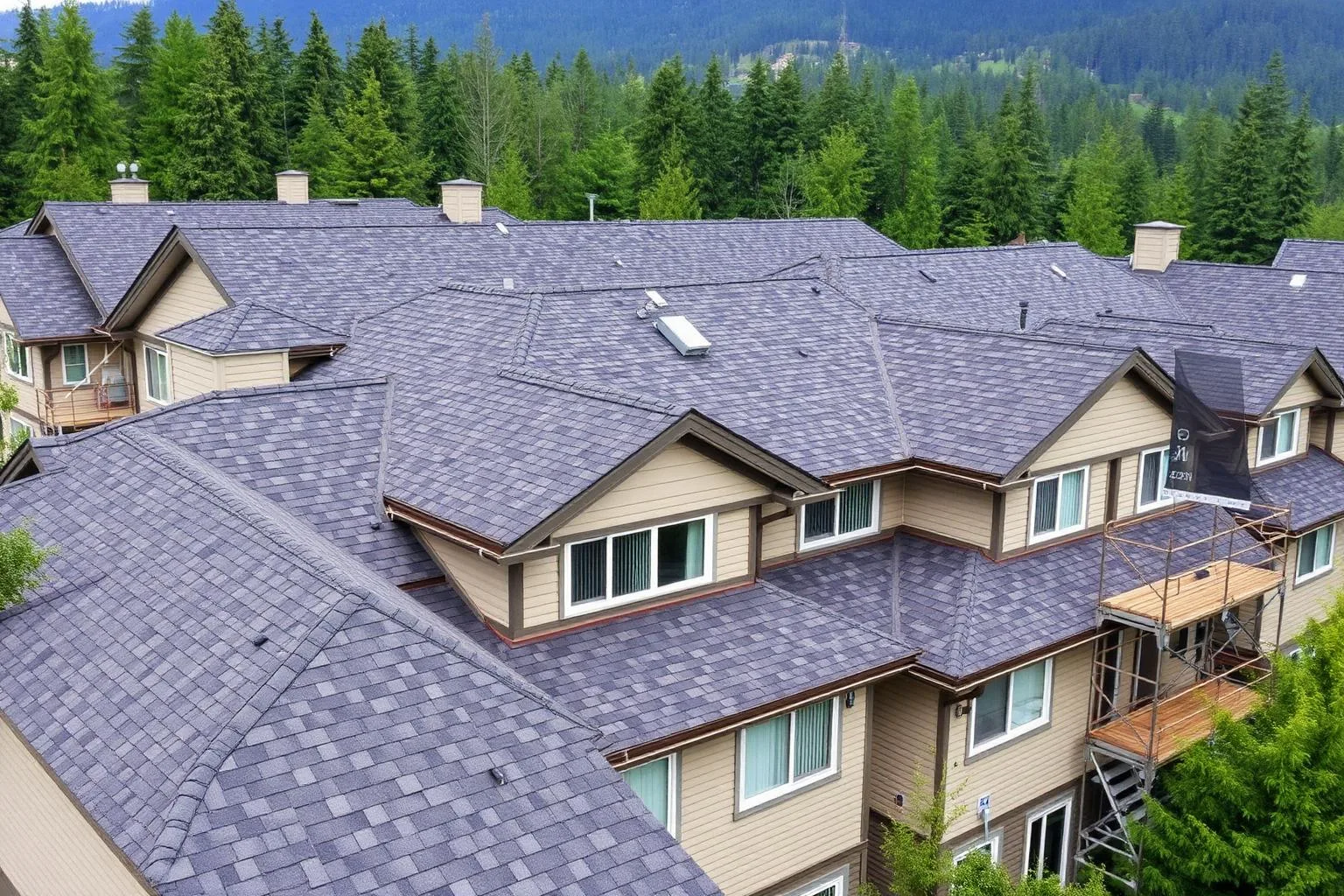
Burke Mountain and Westwood Plateau strata councils run into roof replacement constraints that flat-land Lower Mainland councils almost never see. Elevation drives both wind exposure and snow load. The forested setbacks make crane and material staging difficult. The road grades complicate dump-trailer access. And the entire 2000s and 2010s building stock — built fast during the original Burke Mountain and Westwood master-plan rollouts — is now reaching the 18- to 25-year service-life window where shingle, ridge, and ventilation systems are all simultaneously approaching end of life. This guide is written for strata councils on Burke Mountain, Westwood Plateau, Eagle Ridge and the upper New Horizons catchment facing a 2026 re-roof decision.
What Makes Coquitlam's Hillside Strata Roofs Different
Three building characteristics separate Burke Mountain and Westwood Plateau roofs from the rest of Metro Vancouver. First, the elevation: most of Burke Mountain sits between 200 and 400 metres above sea level, putting it firmly in a different wind-load zone than Coquitlam Centre and well into the snow accumulation belt that begins around 250 metres. Second, the slope geometry: most stratified townhouses on the mountain are built into a hillside with steep driveways, retaining walls, and limited level staging area. Third, the forest setback: cedar and fir canopy directly over many roofs requires more aggressive moss control and creates ventilation challenges that flatter sites do not have.
Each of these characteristics changes the right re-roof specification. Wind load drives ridge cap and starter strip detail. Snow load drives ventilation, ice-and-water shield coverage, and the choice between standard and high-wind shingle products. Forest setback drives moss control specification, gutter sizing, and the placement of downspouts to handle higher concentrated runoff during rain-on-snow events.
Realistic 2026 Cost Ranges for Burke Mountain and Westwood Plateau
Coquitlam hillside re-roof costs in 2026 are running approximately 6 to 10 percent above the Lower Mainland average, driven by access, steeper roof pitches that slow production, and the cost of upgraded wind- and snow-rated assemblies. Per-square-foot installed costs for typical Burke Mountain and Westwood Plateau assemblies in 2026:
- Standard architectural asphalt shingle: $12.00 to $14.50 per square foot of roof area
- Class-4 impact-resistant high-wind shingle: $14.50 to $17.50 per square foot of roof area
- Concrete tile replacement on a higher-end townhouse: $24.00 to $32.00 per square foot of roof area
- Steel or aluminum roof system on a custom complex: $20.00 to $28.00 per square foot of roof area
- Add-on for upgraded ridge venting and ice-and-water shield to eaves plus valleys: $1.00 to $2.00 per square foot
A typical 30-unit Burke Mountain townhouse complex with 24,000 square feet of total roof area is therefore looking at a 2026 cost range between approximately $290,000 and $360,000 for a high-wind architectural shingle assembly with appropriate ventilation and ice-and-water shield upgrades. Councils whose depreciation reports were written from a flat-land cost comparable should expect the actual mountain pricing to come in 8 to 12 percent higher than the report's allowance.
City of Coquitlam Permits and Inspection
Coquitlam requires a building permit for any like-for-like roof replacement above $5,000 in value, which means essentially every strata re-roof. The permit application is simpler and faster than Vancouver or Burnaby — typical review time is 2 to 4 weeks — but the City has been actively enforcing fall-protection inspection during the construction phase since 2023 and the contractor's WorkSafeBC documentation is reviewed at every site visit.
For Burke Mountain projects specifically, the City has occasionally required additional engineering review for wind-load uplift calculations on high-exposure sites above 300 metres elevation. Councils should ask the contractor up-front whether the proposed assembly carries the manufacturer's wind warranty at the specific elevation and exposure of the complex, and require that documentation be included in the permit submission.
Scheduling Around Snow, Wind, and the Spring Melt
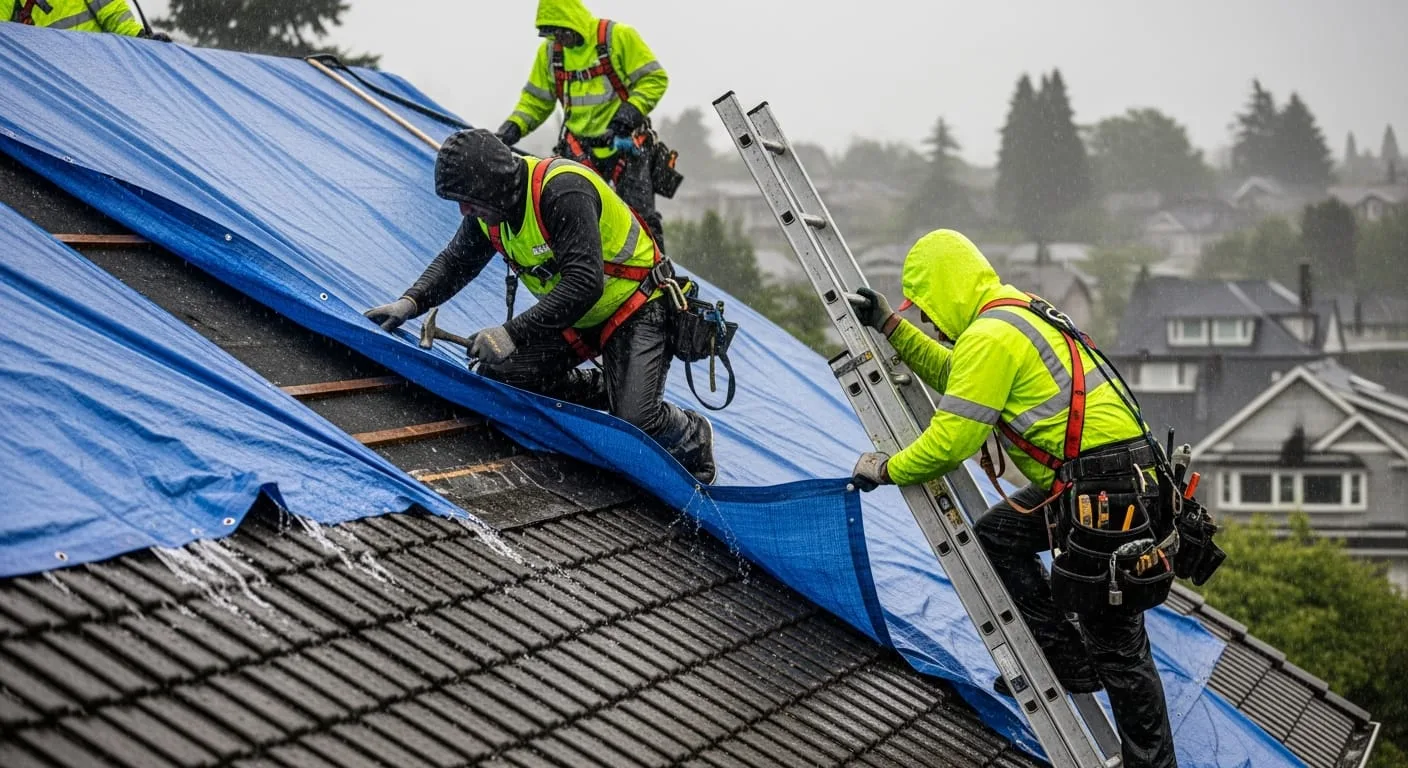
The practical work window on Burke Mountain and the upper Westwood Plateau is mid-May to late September, with a sharp drop in usable work days starting in October. The mountain typically sees its first overnight freeze in early to mid October and the first sticky snow on north-facing slopes by late October or early November. Re-roofs that mobilize after September 1 frequently end up running into weather holds that push completion into November, when overnight freezes complicate ice-and-water shield adhesion and sealant cure times.
Wind events on the mountain are a separate scheduling constraint. Pacific frontal storms producing 50+ km/h sustained winds at the ridge make scaffold work, crane lifts, and any open-deck condition unsafe. Project managers should commit in the contract to a wind-based stop-work threshold and to a defined re-securing procedure for open-deck conditions overnight if weather is forecast to change.
Ventilation Upgrades Most Burke Mountain Strata Need
A surprising number of Burke Mountain and Westwood Plateau strata buildings from the 2000s and early 2010s were originally built with under-designed roof ventilation, and the visible symptom 15 to 20 years later is ice damming at the eaves, premature shingle aging on south-facing slopes, and condensation staining in upper-floor ceilings. A re-roof is the right time to correct this — the incremental cost of adding continuous ridge venting and re-sizing soffit intakes is typically $1.00 to $1.50 per square foot of roof area and the service-life extension is substantial.
Councils should require the contractor to submit a written ventilation calculation showing intake-to-exhaust area ratio meeting BCBC 9.19 requirements and manufacturer recommendations for the chosen shingle. Verbally promised ventilation upgrades without a calculation almost always result in installations that look right from the ground but do not actually meet code.
Forest Canopy, Moss, and Long-Term Maintenance
Burke Mountain and Westwood Plateau roofs sit under more direct tree canopy than almost any other strata catchment in Metro Vancouver. Moss growth is the dominant maintenance issue on shaded northern slopes, and the re-roof spec should include zinc or copper ridge strips that release ions in rainwater to suppress moss growth across the roof surface. The cost is minimal — usually $300 to $500 per ridge — and it extends shingle service life by 3 to 5 years on heavily shaded slopes.
The post-project maintenance plan for Burke Mountain strata should include semi-annual gutter clearing rather than the annual visit typical of flat-land complexes, scheduled after the late-October leaf fall and again after the spring needle drop. Skipping the spring visit is the most common cause of summer-storm overflow damage on mountain townhouses.
Depreciation Report Alignment on the Mountain
Burke Mountain and Westwood Plateau strata corporations from the 2000s build wave typically had their first depreciation reports prepared between 2014 and 2018, and almost all of those reports used flat-land Coquitlam cost comparables that under-budget hillside re-roof costs by 15 to 30 percent. Councils planning a 2026 to 2028 re-roof should commission a depreciation report update before issuing the SGM notice and should specifically request hillside-adjusted cost comparables rather than the original flat-land averages.
Where the updated cost exceeds the original allowance, councils have three options: a single special levy, a multi-year contingency reserve top-up combined with a smaller levy, or a deferred-payment financing arrangement through the contractor or a third-party lender. The right choice depends on the strata's existing reserve health and the owner demographic, but the worst choice is always to defer the project itself hoping costs will fall — they will not.
Insurance, Bonding and Wind-Damage Exposure
Burke Mountain wind events create insurance exposure that flat-land councils rarely consider. A contractor's general liability policy needs to specifically cover wind-uplift damage to adjacent property during construction, including detached items like satellite dishes, vehicles in driveways below the roof line, and trees on adjacent properties. The standard $5 million general liability minimum applies, plus WorkSafeBC clearance, plus a written re-securing procedure for open-deck conditions during forecasted high-wind events.
Strata corporations should also confirm their own building policy's wind-damage coverage and deductible structure before construction begins. A construction-phase wind event that damages an adjacent unit's interior through an unsecured deck is potentially a strata-policy claim with a substantial deductible, and the strata may end up paying out of pocket even when the contractor is at fault. Pre-construction confirmation in writing protects the strata's reserves.
Realistic Burke Mountain Re-Roof Timeline
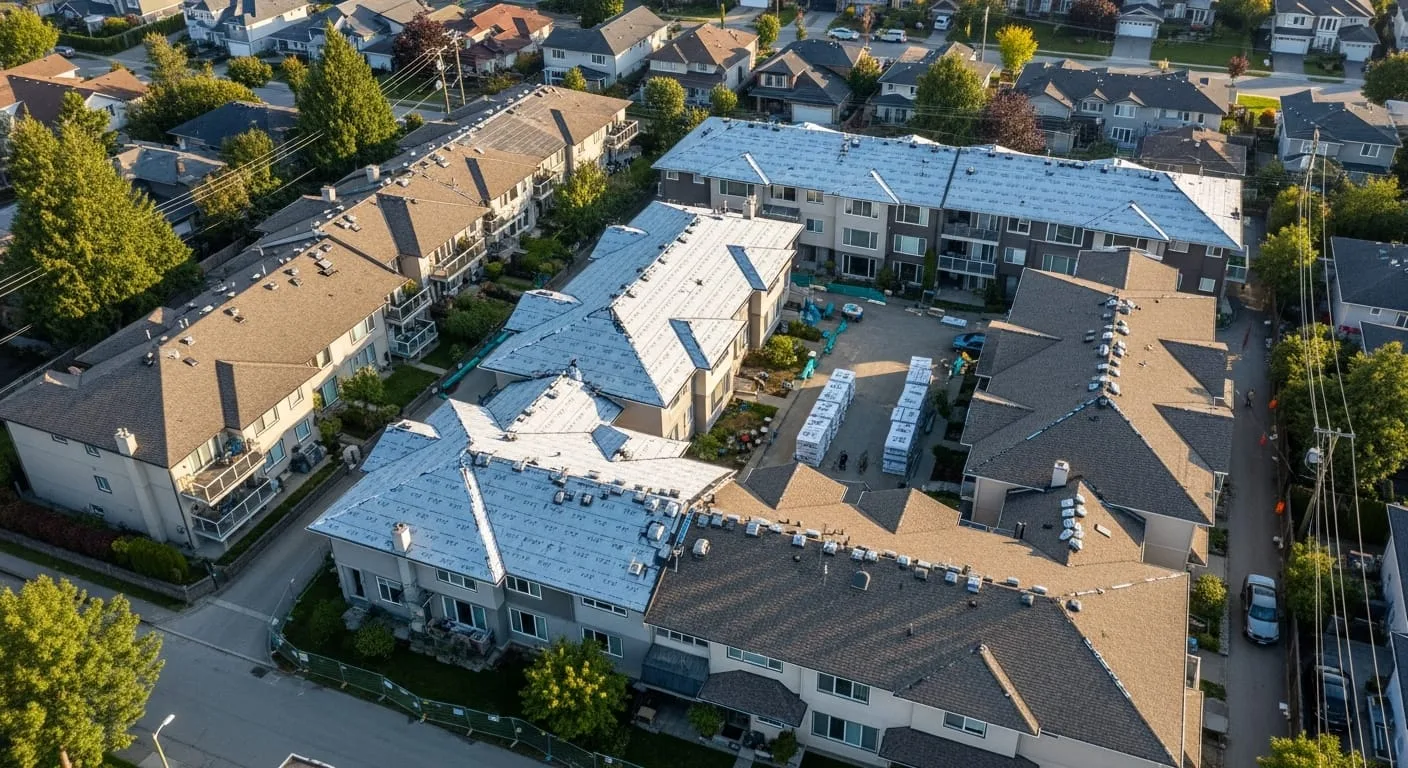
A typical Burke Mountain or Westwood Plateau strata re-roof in 2026 runs 8 to 12 months from first scoping call to project close. Front-end scoping, bid solicitation and SGM vote run 3 to 5 months. Permitting and material lead times add 6 to 10 weeks. Construction is 5 to 9 weeks depending on complex size and weather contingency consumption. Close-out adds 3 to 5 weeks.
Councils starting the process in September or October for a following-summer construction window typically deliver on time. Councils starting in January or February for the same summer routinely miss the optimal May to August window and end up running into the early-October weather risk. The seasonality on the mountain is more pronounced than anywhere else in Metro Vancouver, and the project plan needs to reflect that.
Common Burke Mountain Council Mistakes to Avoid
Across more than 50 Burke Mountain and Westwood Plateau re-roofs we have observed five recurring council mistakes that drive cost overruns and owner disputes. First, specifying a standard wind-rated shingle instead of a high-wind product at elevations above 300 metres, then losing ridge cap or starter strip in the first significant storm. Second, scheduling tear-off mobilization in early October hoping for one last dry stretch, then losing 2 to 3 weeks to weather holds and finishing in November. Third, accepting a verbal moss-control commitment instead of a written zinc-strip spec. Fourth, skipping the ventilation calculation and re-installing the same under-designed system that caused the original ice damming. Fifth, deferring the post-project warranty maintenance visit and discovering deficiencies after the workmanship coverage has expired.
Avoiding each of these is procedural and specification-based rather than budget-based. A council that runs a disciplined scoping process with a contractor experienced on the mountain will see these mistakes flagged before the contract is signed, not after the first storm season.
What Burke Mountain Owners Notice After a Re-Roof
Owner satisfaction on Burke Mountain re-roofs tracks three visible outcomes more than any others. First, the elimination of ice-dam-related winter leaks on upper-floor ceilings. Second, the disappearance of the moss streaks that had accumulated on north-facing slopes over the prior decade. Third, the consistency of shingle colour and ridge profile across the complex, which signals professional workmanship from the ground. Councils that deliver all three see overwhelming AGM support and re-election. Councils that deliver only the first two but leave colour or ridge inconsistencies generate disproportionate complaint volume regardless of the cost savings.
The right contractor will produce on-site colour samples on the actual roof slope at multiple times of day before final ordering, and will photograph the first completed ridge for council sign-off before continuing to the remaining clusters. These two steps add half a day to the schedule and effectively eliminate the most common post-completion complaints.
Talk to a Burke Mountain Strata Roofing Specialist
Strata Roofers BC has completed more than 50 strata re-roofs across Burke Mountain, Westwood Plateau, Eagle Ridge and the broader Tri-Cities since 2014. Fully licensed, insured and bonded with $5 million liability coverage, RCABC-member, and WorkSafeBC compliant. For a no-obligation scoping conversation including wind-load and ventilation review at your specific elevation, call 604-446-3482 or email admin@budgetroofers.ca.
Frequently Asked Questions
- Does a Coquitlam strata need a building permit for a like-for-like re-roof?
- Yes. The City of Coquitlam requires a permit for any roof replacement above $5,000 in value, which covers essentially every strata project. Typical review time is 2 to 4 weeks.
- What does a 30-unit Burke Mountain townhouse re-roof cost in 2026?
- Approximately $290,000 to $360,000 for 24,000 square feet of roof area using a high-wind architectural shingle assembly with upgraded ventilation and ice-and-water shield. Concrete tile and metal systems run substantially higher.
- When is the practical re-roof work window on Burke Mountain?
- Mid-May to late September. Projects mobilizing after September 1 frequently encounter weather holds that push completion into November when overnight freezes complicate adhesion and cure times.
- Do Burke Mountain roofs need a different shingle than flat-land Coquitlam?
- Sites above approximately 300 metres elevation should specify a high-wind rated architectural shingle and verify the manufacturer's wind warranty applies at the specific exposure category of the building.
- How often should a Burke Mountain strata schedule gutter cleaning?
- Twice yearly — after the late-October leaf fall and again after the spring needle drop. Skipping the spring visit is the most common cause of summer-storm overflow damage on mountain complexes.
Need a free assessment?
Licensed · Insured · Bonded roofing across Metro Vancouver.