Strata Roof Replacement in Lynn Valley, North Vancouver: 2026 Council Guide
Published June 16, 2026 · Updated June 16, 2026
Lynn Valley, Upper Lonsdale and the broader District of North Vancouver carry the highest annual rainfall of any strata catchment in Metro Vancouver — typically 1,800 to 2,400 millimetres per year against roughly 1,200 in Vancouver proper. For strata councils on the North Shore, that rainfall load reduces the realistic service life of every roof assembly by roughly 15 to 25 percent compared with regional averages, compresses the practical construction window, and amplifies the cost of any contractor mistake. This guide walks Lynn Valley and Upper Lonsdale strata councils through the full 2026 re-roof workflow specific to the North Shore climate, the District of North Vancouver permit process, and the operational realities of forested, slope-sited complexes.
Why North Shore Re-Roofs Cluster Earlier Than the Region
Lynn Valley and Upper Lonsdale townhouse and low-rise construction concentrated heavily between 1988 and 2008. Original cedar shake roofs from that era reach end of life at roughly 22 to 26 years on the North Shore — three to five years shorter than the Fraser Valley equivalent — putting the replacement wave at 2010 to 2034. Original architectural asphalt shingle roofs from the same era reach end of life at roughly 18 to 24 years under North Shore rainfall, putting that replacement wave at 2006 to 2032. The result is that almost every mid-1990s North Vancouver strata complex is past, at, or within five years of its re-roof decision.
A specific complication on the North Shore is mossy growth and organic acid retention on shaded north-facing slopes under heavy tree cover. Even quality cedar and asphalt assemblies installed in the late 1990s on Lynn Valley slopes have routinely failed at the 18- to 22-year mark from moss-driven granule loss and fastener corrosion rather than from age alone. The 2026 cost estimates below assume tear-off, not over-roofing, on any North Shore assembly older than 18 years.
Realistic 2026 Cost Ranges for Lynn Valley and Upper Lonsdale
North Shore costs in 2026 are running approximately 8 to 14 percent above the Lower Mainland average for comparable assemblies, primarily because of slope access, tree-protection requirements, longer crew transit, and a compressed work window that pushes labour into premium-rate weekends. Per-square-foot installed costs for typical Lynn Valley and Upper Lonsdale assemblies in 2026:
- Single-layer asphalt-to-asphalt re-roof: $11.50 to $14.00 per square foot of roof area
- Single-layer cedar-to-asphalt conversion: $14.00 to $17.50 per square foot of roof area
- Double-layer tear-off (cedar plus shingle) to asphalt: $15.50 to $19.50 per square foot of roof area
- Concrete or composite tile replacement on a higher-end complex: $24.00 to $32.00 per square foot of roof area
- Sheathing replacement allowance (recommend including in contract): $5.00 to $7.50 per square foot of replaced area
A typical 32-unit Lynn Valley townhouse complex with 26,000 square feet of total roof area facing a cedar-to-asphalt conversion is looking at a 2026 cost range of approximately $365,000 to $455,000, plus a 12 to 18 percent contingency for the sheathing allowance. Councils whose depreciation reports were written before 2023 should expect the report's allowance to come in 30 to 50 percent low against this range and should rebuild the reserve plan accordingly.
District of North Vancouver Permits and Process
The District of North Vancouver requires a building permit for any roof replacement on a stratified property, including like-for-like asphalt replacements. Review times in 2026 are running 4 to 6 weeks for a complete submission, longer than most other Metro Vancouver municipalities, driven primarily by the District's tree-protection and erosion-control reviews on forested sites. Submissions missing a tree-protection plan are routinely returned at first review.
Any cedar-to-asphalt conversion in the DNV requires an engineer's letter confirming the existing structure can carry the new load, and any complex within a designated Riparian Area or with steep-slope hazard ratings requires additional environmental sign-off. Contractors who have not previously worked in Lynn Valley or Upper Lonsdale frequently underestimate the permit timeline by 3 to 4 weeks, which then compresses the construction window into October weather risk.
The North Shore Rainfall Reality
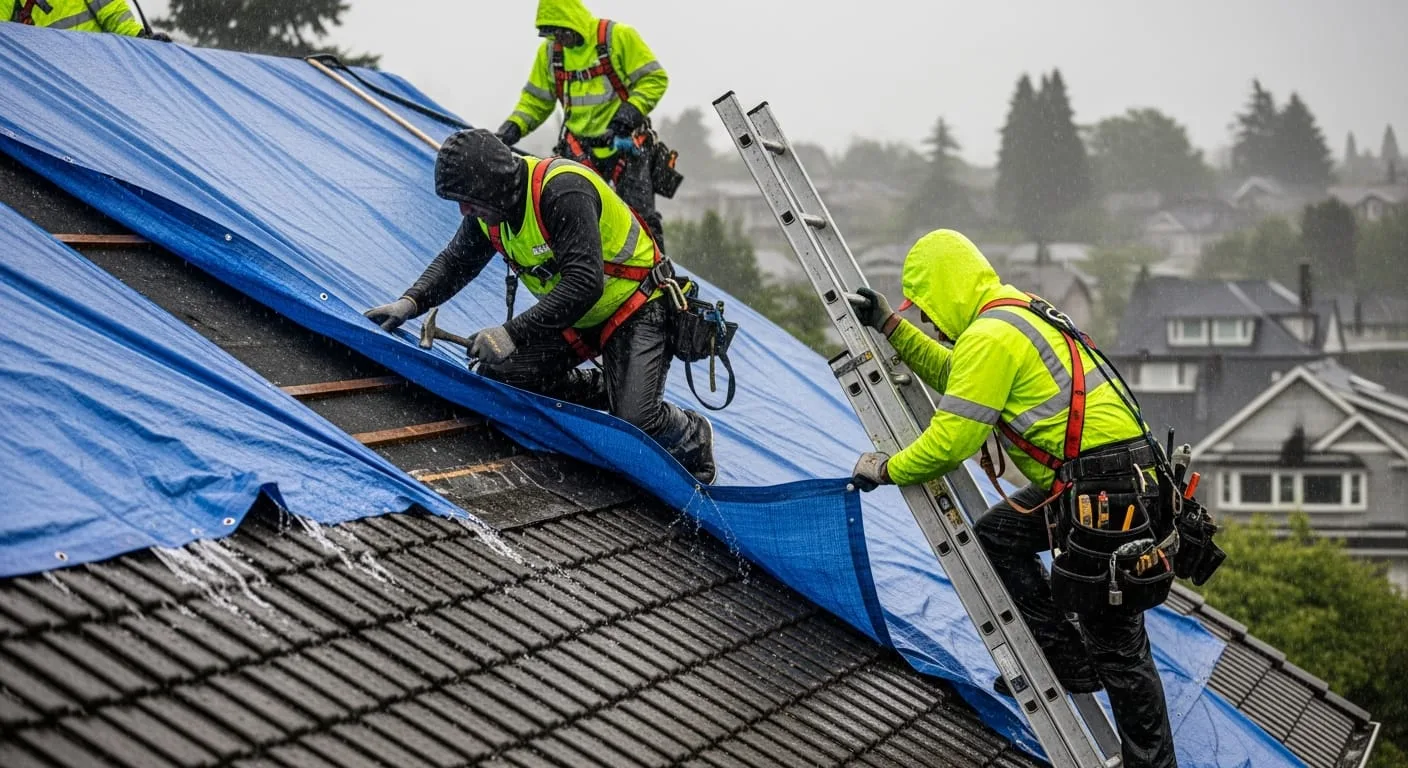
The practical re-roof window on the North Shore is shorter than anywhere else in Metro Vancouver: late May through mid-September with reasonable confidence, with significant weather risk in May and September shoulder weeks. Crews who work into October on the North Shore routinely lose 35 to 50 percent of scheduled days to rain, which doubles the active project duration and adds tarping, dry-in and re-mobilization costs that were not in the original contract.
A 32-unit Lynn Valley complex typically schedules across 5 to 7 weeks of working time inside the dry window, broken into 4-unit clusters with a 35 percent weather contingency built into the calendar. Councils who insist on a fixed 5-week schedule without weather contingency invariably end up with either an October finish in the rain or a contractor walk-off and a re-tender at higher rates.
Cedar-to-Asphalt Conversion on the North Shore
Cedar-to-asphalt conversion is the dominant re-roof decision in Lynn Valley and Upper Lonsdale in 2026, but the North Shore variant carries two specific design considerations the Fraser Valley does not. First, the heavy organic load from surrounding evergreens means the asphalt product should be specified with copper or zinc strip detailing at ridges to suppress moss growth — adding $0.40 to $0.75 per square foot but extending realistic service life by 4 to 7 years. Second, the heavier visual weight of architectural shingle reads particularly strongly against the cedar siding and dark exterior palettes common in Lynn Valley, so colour selection should be reviewed on site at multiple times of day before the SGM vote, not after.
The right asphalt product for a former cedar complex on the North Shore is a 40-year laminated architectural shingle with Class A fire rating, a 130 mph high-wind warranty, and integrated algae-resistance granules. Lower-spec architectural products that work fine in Langley underperform on the North Shore by roughly the lifespan margin between the climates.
Tree Protection and Site Access
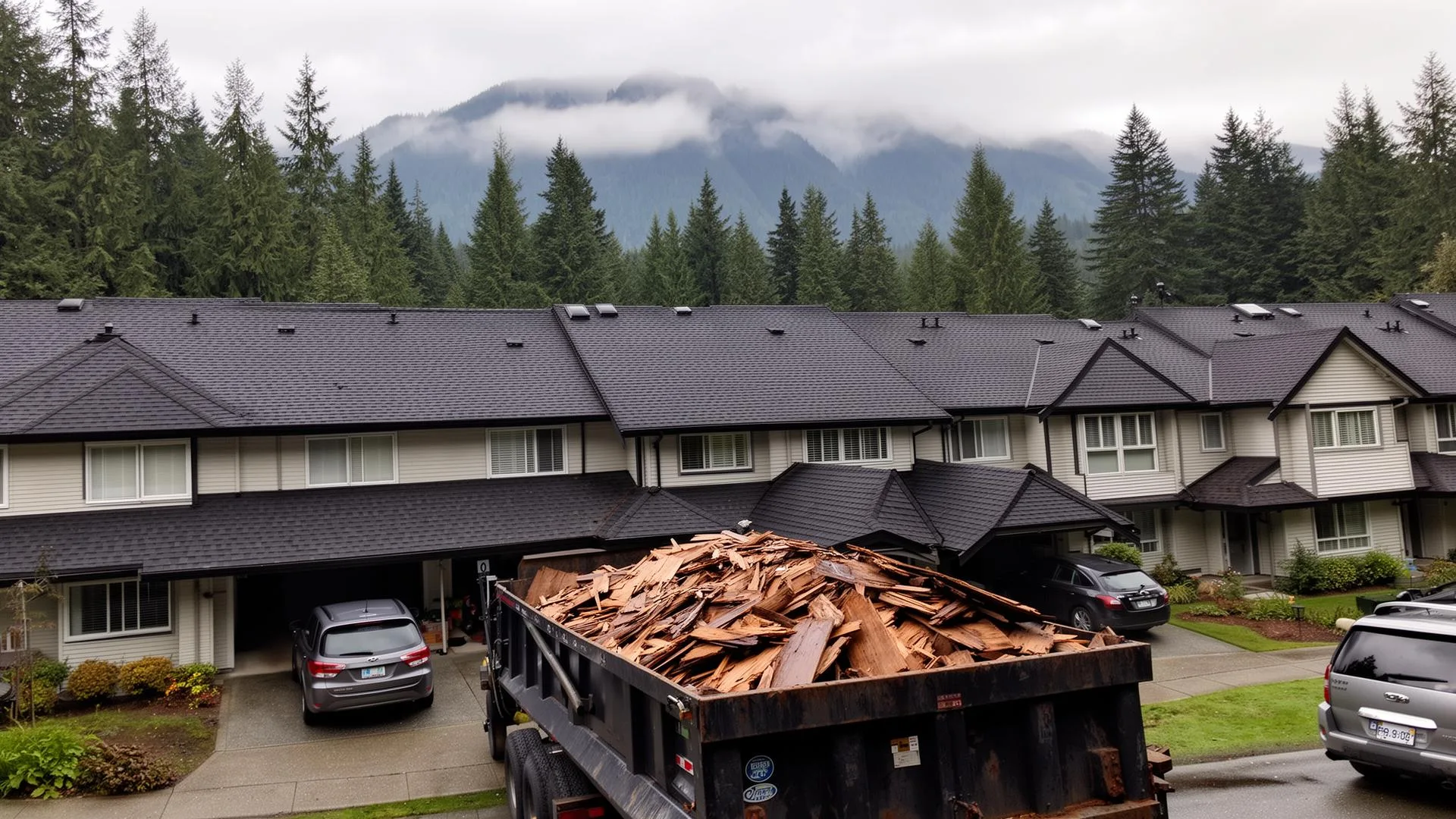
Almost every Lynn Valley and Upper Lonsdale complex is sited within or adjacent to mature evergreen stands that are either protected by the DNV's tree bylaw, by the strata's own bylaws, or by both. Tree-protection fencing, crown-cleaning before tear-off, and root-zone protection during dump-trailer staging are line items the contractor must price into the bid. Bids that ignore these requirements are functionally non-compliant — they will either trigger a stop-work order on day one or generate damage claims from owners whose mature plantings are crushed by a 40-foot trailer.
Site access on Lynn Valley slope sites is the other recurring cost driver. Single-lane driveways, switchback parking layouts, and tight turning radii frequently require smaller-format equipment, more frequent disposal runs, and on a meaningful fraction of complexes a crane-set for delivering materials to the upper buildings. Councils should ask every bidder to walk the site and provide a written site-access plan before the bid is accepted.
Sheathing Replacement: The Hidden North Shore Cost
Cedar-era North Shore townhouses uncover deteriorated plywood or OSB sheathing more frequently than any other Metro Vancouver catchment — typical sheathing-replacement rates on Lynn Valley cedar tear-offs run 12 to 22 percent of roof area, against 5 to 12 percent in Langley. The 2026 contract should explicitly include a sheathing allowance of 15 to 20 percent of roof area at $5.00 to $7.50 per square foot of replaced area. Overages above the allowance should trigger a written change order signed by the council president, not by an owner on site.
Contractors who decline to include a generous sheathing allowance on a North Shore project are usually contractors who plan to bill it on a per-sheet basis during tear-off with no upper bound. That is the structure that produces unpredictable final invoices and contract disputes — and on the North Shore, where sheathing damage rates are highest, it is the single most common reason a Lynn Valley re-roof project goes over budget by 30 percent or more.
Insurance Implications of the Cedar Conversion Wave
Several Lower Mainland insurers have either non-renewed or sharply re-priced policies on cedar shake buildings on the North Shore since 2021, and the trend has accelerated since the 2023 wildfire season placed the District of North Vancouver inside the urban-interface risk envelope. Lynn Valley and Upper Lonsdale strata councils carrying original cedar shake roofs are seeing premium increases of 35 to 75 percent at renewal, plus deductible structures that effectively transfer most wind and fire risk back onto the strata's reserve. Converting to asphalt during a re-roof typically reverses that premium trajectory at the following renewal — councils should ask their broker for a written quote on both the existing cedar continuation and the post-conversion asphalt premium before finalizing the SGM scope so that owners can see the insurance savings as part of the conversion business case.
The insurance argument frequently moves owners who are otherwise reluctant to approve the special levy. Showing that the conversion produces an immediate $300 to $800 per door per year premium reduction at the next renewal is more persuasive on the North Shore than any technical argument about cedar service life.
Depreciation Report Updates for North Shore Councils
Lynn Valley and Upper Lonsdale depreciation reports prepared between 2014 and 2019 universally underestimate 2026 cedar-to-asphalt conversion costs by 35 to 55 percent, primarily because the original reports rarely modeled the North Shore sheathing-damage rate, the tree-protection cost, or the compressed work window. Councils planning a 2026 to 2028 conversion should commission a report update including all three before issuing any SGM notice. The update costs $1,800 to $4,000 and prevents the most common failure mode on North Shore re-roofs: an SGM vote that approves a special levy too small to cover the contract once sheathing overages and weather extensions land.
Where the updated cost exceeds the original allowance, councils should consider a combined funding approach: a special levy for the immediate gap plus a contingency reserve top-up over the following 2 to 3 years. Trying to cover the entire delta through one special levy on short notice produces owner pushback that delays the project past the narrow North Shore construction window.
Realistic Lynn Valley Re-Roof Timeline
A typical 24- to 40-unit Lynn Valley or Upper Lonsdale cedar-to-asphalt conversion in 2026 runs 11 to 15 months from first scoping call to project close. Scoping, bid solicitation, council review and SGM vote take 4 to 6 months. Permitting, engineer's letter, tree-protection plan and material lead times add 8 to 12 weeks. Construction runs 5 to 7 weeks for a 24-unit complex and 8 to 11 weeks for a 40-unit complex inside the dry window. Close-out, warranty registration, deficiency walk-through and final invoicing take 5 to 8 weeks.
Councils that begin scoping in the previous fall for the following May-to-September window deliver on schedule almost without exception. Councils that begin in late winter for the same summer window typically end up unable to permit in time and slip a full year — a particularly expensive outcome on the North Shore because of the per-month cost of carrying a failing cedar roof through another wet season.
Owner Communication on a Forested Slope Site
Lynn Valley and Upper Lonsdale complexes have an above-average rate of long-tenure owners, many of whom care intensely about mature trees, view corridors and exterior aesthetics. Communication infrastructure has to reflect that: a single project email list, a weekly written update, a single project phone number, a posted tree-protection map, and an in-person owner drop-in session every 2 weeks during active construction are the minimum. The drop-in session is especially effective on the North Shore because it allows owners to walk the tree-protection fencing and the staging plan in person with the project manager.
The most common communication failure on Lynn Valley re-roofs is under-communicating during weather holds. Owners assume any pause in visible work is contractor delay. A weather-hold notice the morning of the hold, with the rainfall forecast that triggered it and the expected resumption date, prevents almost all of the complaints that otherwise drive AGM challenges to the council.
Common Lynn Valley Council Mistakes to Avoid
Across more than 55 Lynn Valley and Upper Lonsdale re-roofs we have observed several recurring council mistakes. First, accepting a bid without a written sheathing replacement allowance and then watching the final invoice climb 25 to 45 percent above the contract as the North Shore's high sheathing-damage rate materializes. Second, accepting a bid without a written tree-protection plan and absorbing a damage claim from owners whose mature plantings are destroyed during staging. Third, scheduling tear-off in May or September hoping to extend the window, then losing weeks to rain and pushing crews into October. Fourth, choosing a regional-average asphalt product without copper or zinc moss-suppression detailing, then watching moss return within four years. Fifth, skipping the insurance broker conversation before the SGM and missing the opportunity to present 35 to 75 percent premium savings as part of the conversion business case.
Each of these is preventable with a disciplined front-end process. The right contracting partner will help the council structure the contract, the communication plan, and the owner-facing business case so that the project closes inside the North Shore dry window, on budget, and with overwhelming owner support at the following AGM.
Talk to a Lynn Valley Strata Roofing Specialist
Strata Roofers BC has delivered more than 55 strata re-roofs across Lynn Valley, Upper Lonsdale, Capilano and the broader District of North Vancouver since 2014, including dozens of cedar-to-asphalt conversions on slope-sited and tree-protected complexes. Fully licensed, insured and bonded with $5 million liability coverage, RCABC-member, and WorkSafeBC compliant. For a no-obligation scoping conversation including sheathing-condition forecasting and tree-protection planning, call 604-446-3482 or email admin@budgetroofers.ca.
Frequently Asked Questions
- Does the District of North Vancouver require a building permit for a strata re-roof?
- Yes. The DNV requires a building permit for any roof replacement on a stratified property. Typical review time in 2026 is 4 to 6 weeks for a complete submission with engineer's letter, tree-protection plan and waste-management plan.
- What does a 32-unit Lynn Valley cedar-to-asphalt conversion cost in 2026?
- Approximately $365,000 to $455,000 for 26,000 square feet of roof area, plus a 12 to 18 percent contingency for sheathing replacement. North Shore costs run 8 to 14 percent above the regional average primarily because of access, tree protection and the compressed work window.
- Why are sheathing-damage rates higher in Lynn Valley than in the rest of Metro Vancouver?
- The North Shore receives roughly twice the annual rainfall of Vancouver proper, plus heavy organic loading from surrounding evergreens. Together these accelerate plywood and OSB deterioration under cedar and shingle assemblies, producing typical replacement rates of 12 to 22 percent of roof area on tear-off.
- What is the practical re-roof window on the North Shore?
- Late May through mid-September with reasonable confidence. May and September shoulder weeks carry meaningful weather risk, and any work scheduled into October typically loses 35 to 50 percent of days to rain.
- Why does our Lynn Valley project need a tree-protection plan?
- Almost every Lynn Valley and Upper Lonsdale complex is sited within or adjacent to mature evergreen stands protected by the DNV's tree bylaw, by strata bylaws, or both. The DNV will return permit submissions missing tree-protection documentation, and damaged trees during staging generate owner claims that often exceed the cost of doing the protection correctly.
Need a free assessment?
Licensed · Insured · Bonded roofing across Metro Vancouver.