Strata Roof Replacement in New Westminster, BC: A 2026 Heritage and Hillside Guide
Published June 17, 2026 · Updated June 17, 2026
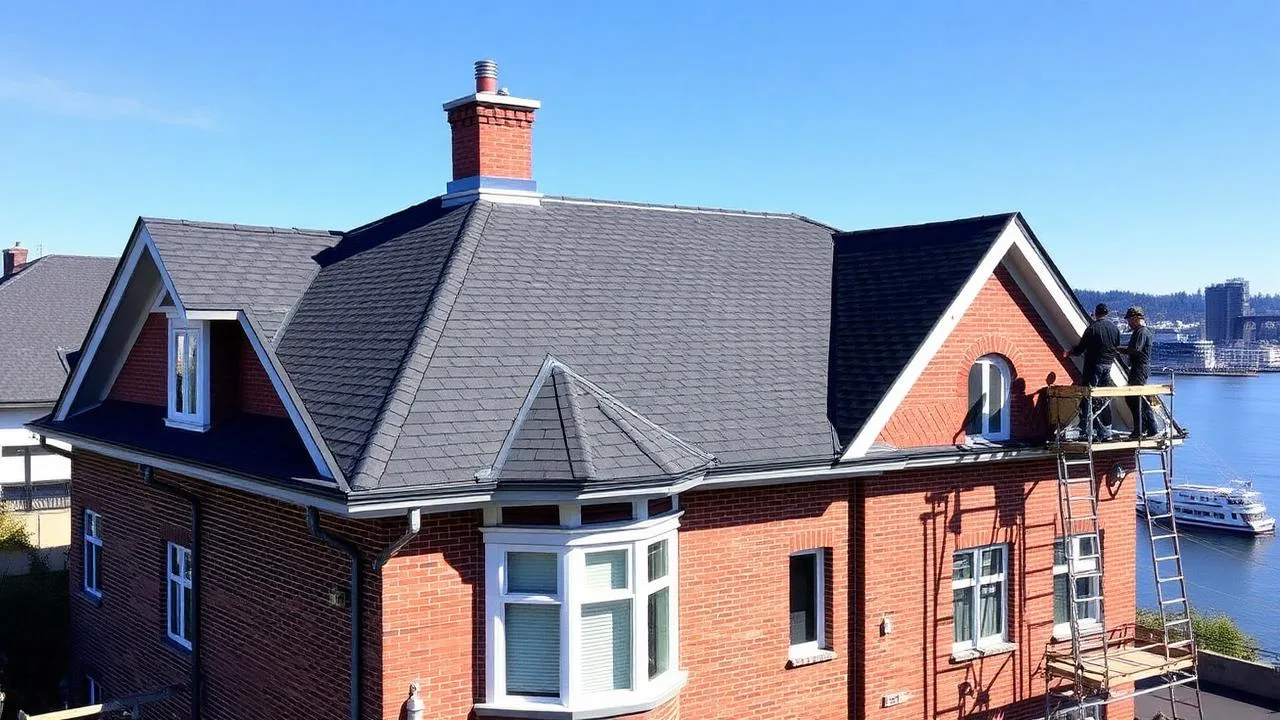
New Westminster is Metro Vancouver's oldest city, and its strata roof replacement market reflects that history. The catchment spans Queens Park heritage homes converted to small stratas, Sapperton brick walk-ups from the 1920s and 1930s, 1990s wood-frame mid-rises along Uptown's Sixth Street corridor, and 2010s concrete towers along the Quay. Each requires a fundamentally different re-roof scope, permit path and contractor skill set. This guide is written for New Westminster strata councils planning a 2026 or 2027 replacement on any of those building types.
Four Distinct New Westminster Roof Markets
New Westminster's re-roof market splits into four operationally distinct segments. Heritage strata in Queens Park and the West End operate under the City's Heritage Conservation Area bylaws and require Heritage Alteration Permits for any visible roof change, including colour, profile and material. Sapperton brick walk-ups typically have flat or low-slope tar-and-gravel or SBS membranes that have been overlaid multiple times and now require complete tear-off. Uptown wood-frame mid-rises from the 1990s and 2000s are reaching the end of their original asphalt shingle service life. Quay concrete mid- and high-rises have first-generation TPO and SBS membranes coming due for replacement.
Mis-categorizing the building at the bid stage produces bids from contractors who cannot deliver the work — heritage Queens Park projects bid by Sapperton flat-roof contractors fail at the Heritage Alteration Permit stage, and Quay high-rise projects bid by Uptown townhouse contractors fail at the WorkSafeBC fall-protection stage.
Heritage Conservation Areas and Heritage Alteration Permits
New Westminster's Heritage Conservation Areas — most prominently Queens Park, but also designated streetscapes in the West End and Sapperton — require a Heritage Alteration Permit (HAP) for any visible roof change. The HAP process reviews material, colour, profile and visible flashing detail against the City's Heritage Conservation Area guidelines. Common approval issues include shingle colour shifts away from the building's original palette, profile changes from cedar to dimensional asphalt without compensating detailing, and replacement of original copper or galvanized flashings with modern aluminum.
HAP review typically runs 6 to 10 weeks in 2026 and requires drawings, manufacturer documentation, colour samples and (for designated heritage properties) a Statement of Significance from a heritage consultant. Councils in Heritage Conservation Areas should engage the heritage consultant 4 to 6 months before the intended construction window — skipping that step is the single most common cause of slipped Queens Park projects.
Realistic 2026 Cost Ranges for New Westminster
- Uptown wood-frame architectural asphalt re-roof: $10.50 to $13.50 per square foot
- Queens Park heritage asphalt re-roof with HAP-compliant detailing: $13.50 to $18.00 per square foot
- Queens Park heritage cedar shake replacement (where required): $22.00 to $30.00 per square foot
- Sapperton low-rise SBS torch-on tear-off and replacement: $17.00 to $22.00 per square foot
- Quay mid-rise TPO single-ply with crane access: $19.00 to $26.00 per square foot
- Quay high-rise PVC single-ply with engineered fall-protection: $24.00 to $32.00 per square foot
A typical 24-unit Uptown wood-frame complex with 18,000 square feet of roof area should budget approximately $200,000 to $260,000 in 2026. A 12-unit Queens Park heritage strata typically lands $50,000 to $90,000 higher than equivalent square footage in Uptown because of HAP-compliant detailing, copper flashing and the longer permit timeline. Quay mid-rises run on par with Brentwood and Metrotown comparables.
City of New Westminster Permits
New Westminster requires a building permit for any strata roof replacement that involves more than simple re-cover, plus a separate Heritage Alteration Permit for properties in a Heritage Conservation Area or designated heritage register. The building permit review typically runs 3 to 5 weeks for a complete submission. Where a HAP is required, the HAP review runs in parallel but typically governs the critical path.
WorkSafeBC fall-protection requirements are enforced strictly on Quay mid- and high-rise projects, with engineered fall-protection plans required for any building above 4 storeys. Hillside Sapperton sites with significant elevation differential between front and rear elevations frequently require additional anchor-point engineering even on low-rise buildings.
Hillside Access in Sapperton and Uptown
Much of Sapperton and parts of Uptown sit on steep hillside lots that drop sharply from the street toward the Fraser River. The practical consequence for re-roof projects is that material delivery, dump-trailer staging and crane positioning are all complicated by the grade. On many Sapperton sites the only viable equipment access is from an adjacent lane or from a temporary closure of East Columbia Street, and the contractor should walk the site with the equipment operator at least 60 days before mobilization.
Hillside projects also frequently uncover deteriorated sheathing at the downhill eaves where water has been accumulating against fascia for decades. Budget a 12 to 18 percent sheathing allowance on Sapperton hillside projects against the 5 to 12 percent typical of flat-lot Uptown work.
Material Selection in Heritage Contexts
Heritage Alteration Permit reviews in Queens Park typically require either an authentic material replacement (cedar shake for cedar shake, slate for slate where original) or a high-end dimensional architectural asphalt in a heritage-appropriate colour. The right asphalt product for a Queens Park project is a premium 50-year architectural shingle with a heritage colour palette — typically deep slate, weathered wood or aged copper tones — paired with copper or pre-weathered zinc flashings rather than mill-finish aluminum.
Cedar-to-asphalt conversions are permitted in some Queens Park sub-areas but require specific HAP justification and a colour match that reads as cedar from the streetscape. Councils contemplating a cedar-to-asphalt conversion in a Heritage Conservation Area should book a pre-application meeting with the City's heritage planner before issuing the SGM notice.
Owner Communication in Mixed-Tenure New Westminster Stratas
New Westminster has one of the highest rates of non-resident landlord ownership in Metro Vancouver, particularly in Uptown and along the Quay. Communication infrastructure has to scale for both resident and non-resident audiences: a project-specific email list with both registered owner addresses and resident addresses, a weekly written update, a single project phone number, and a clear policy on tenant notification responsibility — owner versus property manager versus contractor.
Heritage Queens Park stratas frequently have long-tenure, multi-decade resident owners who care intensely about visible exterior change. An in-person owner drop-in session before the SGM vote, with a mock-up shingle panel installed on a temporary frame at the property, materially improves SGM approval rates and reduces post-installation complaints.
Depreciation Report Updates for New Westminster
Depreciation reports prepared between 2014 and 2019 routinely underestimate 2026 New Westminster re-roof costs by 35 to 55 percent in heritage contexts and 25 to 40 percent elsewhere. Heritage projects in particular are systematically under-allowanced because the original reports rarely modeled HAP-compliant detailing, copper flashing or premium heritage shingle products. Councils planning a 2026 to 2028 heritage re-roof should commission an updated cost projection from a consultant familiar with the City's HAP requirements.
Realistic New Westminster Re-Roof Timeline
Timelines vary sharply by building type. A typical Uptown wood-frame re-roof runs 8 to 11 months from scoping to close. Sapperton low-rise membrane work runs 9 to 12 months because of hillside access logistics. Queens Park heritage projects run 12 to 16 months because of the HAP review and the seasonal heritage consultant capacity. Quay mid-rise membrane work runs 10 to 14 months. Councils should plan accordingly and avoid the trap of assuming a heritage project can be scoped, approved and built inside a single calendar year.
Common New Westminster Council Mistakes to Avoid
Across more than 50 New Westminster strata re-roofs we have observed several recurring mistakes. First, scoping a Queens Park heritage project without engaging a heritage consultant and discovering at HAP review that the shingle colour or flashing material is not approvable. Second, accepting a bid on a Sapperton hillside site without a written site-access plan and a 15 percent sheathing allowance. Third, under-budgeting heritage projects because the depreciation report did not anticipate the heritage premium. Fourth, treating a Quay high-rise as a scaled-up low-rise and inviting low-rise bidders without high-rise fall-protection experience. Fifth, under-communicating with non-resident landlords on Uptown projects and absorbing AGM challenges from owners who felt uninformed.
Talk to a New Westminster Strata Roofing Specialist
Strata Roofers BC has delivered more than 50 strata re-roofs across Queens Park, Uptown, Sapperton, the Quay and the West End since 2014, including heritage projects with full Heritage Alteration Permits and Quay high-rise membrane replacements. Fully licensed, insured and bonded with $5 million liability coverage, RCABC-member, WorkSafeBC compliant. For a no-obligation scoping conversation including HAP-readiness review where applicable, call 604-446-3482 or email admin@budgetroofers.ca.
Frequently Asked Questions
- Does our Queens Park strata need a Heritage Alteration Permit to re-roof?
- Yes for any visible roof change including shingle material, colour or flashing visible from the streetscape. HAP review typically runs 6 to 10 weeks and should be initiated 4 to 6 months before the intended construction window.
- What does a 12-unit Queens Park heritage re-roof cost in 2026?
- Approximately $130,000 to $190,000 for 10,000 square feet of HAP-compliant architectural asphalt with copper flashing detailing — typically $50,000 to $90,000 above comparable Uptown wood-frame pricing.
- Can we convert a cedar shake roof to asphalt in Queens Park?
- Possibly, with HAP approval and a colour and profile match that reads as cedar from the streetscape. Book a pre-application meeting with the City's heritage planner before issuing the SGM notice.
- Why does our Sapperton hillside project need a bigger sheathing allowance?
- Hillside sites typically have decades of accumulated water damage at the downhill eaves where fascia drainage has been compromised. Sapperton sheathing replacement rates average 12 to 18 percent of roof area against 5 to 12 percent on flat-lot work.
- How far in advance should a Queens Park council start scoping?
- 12 to 16 months before the desired construction window, including 4 to 6 months for heritage consultant engagement and HAP review. Trying to complete a heritage project inside a single calendar year almost always slips into the next.
Need a free assessment?
Licensed · Insured · Bonded roofing across Metro Vancouver.