Strata Roof Replacement in Richmond, BC: A 2026 Council Guide
Published June 17, 2026 · Updated June 17, 2026
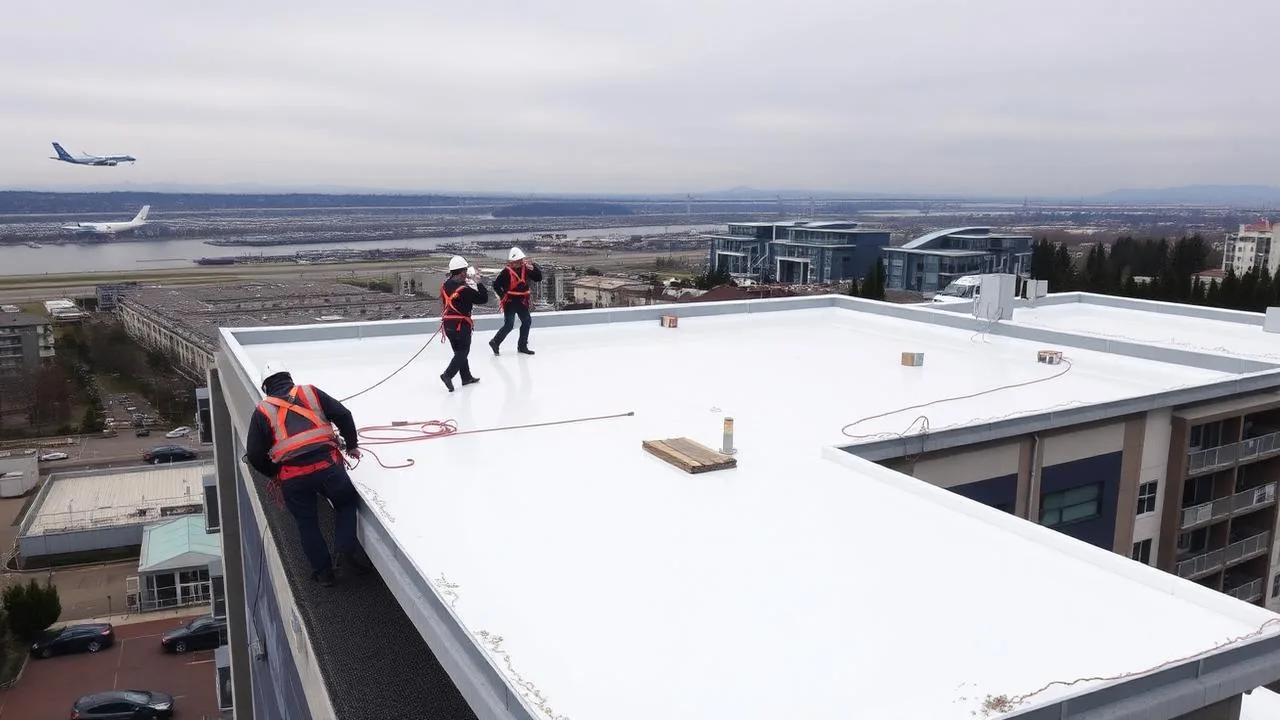
Richmond has the highest concentration of low-slope and flat-roof strata buildings in British Columbia. The combination of post-1990 mid-rise condo development across Brighouse, Steveston, West Cambie and Hamilton — almost universally specified with flat membrane assemblies — and the Fraser River delta's sea-level wind, salt and seismic exposure produces a re-roof market that looks very different from the steep-pitched townhouse work in Surrey or Coquitlam. This guide is written for Richmond strata councils facing a 2026 or 2027 flat-roof replacement decision.
What Makes Richmond Roofs Different
Four Richmond-specific factors shape every flat-roof replacement decision. First, the building stock is overwhelmingly low-slope membrane — typically 2-ply SBS torch-on from the 1990s and 2000s and single-ply TPO or PVC from 2005 onward. Second, the entire municipality sits at or near sea level on Fraser River delta soils, with a significantly higher water-table and lower drainage gradient than the rest of Metro Vancouver. Third, salt-laden marine air accelerates corrosion of metal flashings, drain bowls and HVAC curbs. Fourth, the YVR flight path and tighter Richmond noise bylaws constrain when crews can work, particularly on residential mid-rises in Brighouse and West Richmond.
The combined effect is that Richmond flat-roof projects reward contractors who specify marine-grade flashings, design positive drainage with engineered taper systems, and schedule crew arrivals and material deliveries inside the City's noise-bylaw windows.
Realistic 2026 Cost Ranges for Richmond Strata
- Low-rise SBS two-ply torch-on tear-off and replacement: $17.00 to $22.00 per square foot of roof area
- Mid-rise TPO single-ply with crane access: $19.00 to $26.00 per square foot
- Mid-rise PVC single-ply (recommended for salt-air exposure): $22.00 to $30.00 per square foot
- Tapered insulation system to engineer positive drainage: $4.00 to $7.00 per square foot of taper area
- Marine-grade stainless flashing and drain bowl upgrade: $850 to $1,800 per drain location
A typical 60-unit Brighouse mid-rise with roughly 9,500 square feet of roof area should budget approximately $215,000 to $290,000 for a PVC single-ply replacement including tapered insulation, marine flashings, engineering, permits and contingency. Steveston low-rise wood-frame projects with 2-ply SBS run lower per project but higher per square foot because of the smaller roof areas and the higher labour-to-material ratio.
City of Richmond Permits and Engineering
Richmond requires a building permit for any strata roof replacement that involves a change in assembly type, any tapered insulation system, any drain relocation, or any work on a stratified building above 3 storeys. The application requires a sealed structural engineer's letter confirming the existing structure can carry the proposed assembly weight, manufacturer documentation, a waste-management plan and WorkSafeBC notice of project.
Richmond permit review in 2026 typically runs 3 to 6 weeks, with mid-rise projects on the longer end. The City has been particularly active on drainage compliance since the 2023 atmospheric river events: applications that do not include an engineered positive-drainage plan on roofs with persistent ponding history are routinely sent back at first review.
Membrane Selection for Salt-Air and Sea-Level Conditions
Three membrane families dominate the Richmond market in 2026. PVC single-ply is the technical first choice for salt-air exposure because of its chemical resistance to airborne marine salts and rooftop HVAC discharge — it carries a meaningful premium but delivers materially longer service life on coastal exposures. TPO single-ply is the lowest-installed-cost option and delivers a credible 20- to 25-year service life inland of the riverfront but should be specified carefully near the Steveston waterfront. SBS two-ply torch-on remains the most physically durable option, particularly under foot traffic and rooftop amenity use, but the labour pool for skilled torch-on installation is shrinking and the schedule premium has grown.
For a typical Brighouse mid-rise without unusual chemical exposure, TPO is usually the right answer. For Steveston waterfront buildings, buildings adjacent to commercial kitchens, or buildings with rooftop air-handling equipment discharging on the membrane, PVC is the better long-term choice. Specify the membrane in consultation with the manufacturer's technical rep, not from a generic spec sheet.
Drainage: The Single Biggest Richmond Failure Mode
Persistent ponding water is the dominant Richmond roof failure mode and the single biggest driver of premature membrane replacement. The 1990s and early 2000s flat-roof stock was almost universally built with minimal slope to drain, and 25 years of settlement on delta soils has produced ponding zones that void most manufacturer warranties.
Any 2026 Richmond re-roof scope should include an engineered tapered insulation system designed to deliver minimum 1/4-inch per foot slope to drain at every drainage point, with crickets at all penetrations and parapet returns. The incremental cost over a flat-insulation install is $4.00 to $7.00 per square foot of taper area and is the single highest-ROI specification upgrade available on a Richmond project. Skipping the taper to save money is the most common cause of a 25-year roof failing at year 12.
Marine-Grade Flashings and Drain Hardware
Salt-laden marine air corrodes standard galvanized and aluminum flashings, drain bowls and HVAC curbs much faster in Richmond than in the rest of Metro Vancouver. The right Richmond specification in 2026 uses stainless steel or copper flashings at all roof-to-wall transitions, parapet caps and skylight curbs, and cast-iron or stainless drain bowls rather than aluminum. The incremental cost is roughly $850 to $1,800 per drain location and proportional at other flashing details. Councils who accept galvanized flashings to save money see corrosion-driven leaks beginning at year 8 to 12 on otherwise sound membranes.
Working Around YVR Flight Paths and Noise Bylaws
Richmond's noise bylaw restricts construction noise on residential properties to 7 AM to 8 PM weekdays and 9 AM to 8 PM Saturdays, with no Sunday or statutory holiday work without a special permit. On strata mid-rises in Brighouse and West Cambie, residents are generally tolerant of weekday membrane work but intolerant of early-morning material deliveries that conflict with the YVR overhead noise envelope. Schedule deliveries between 9 AM and 4 PM and confirm crane operations with the strata's neighbouring buildings in advance.
Seismic and Geotechnical Considerations
Richmond's Fraser River delta soils have the highest seismic liquefaction risk in Metro Vancouver. While seismic engineering is the responsibility of the original building design, re-roofing creates an opportunity to confirm that rooftop mechanical equipment is properly seismic-restrained, that ballast on inverted-membrane assemblies meets current code, and that parapet attachments have not loosened over the building's service life. A 2026 re-roof scope should include a written rooftop seismic walk-through with the structural engineer at the design stage, not as a change order during construction.
Insurance, Bonding and WorkSafeBC
Richmond councils should require $5 million general liability as the minimum for any project above 30 units, $10 million for mid-rise projects above 50 units, and a performance bond on the full contract value for any project above $250,000. WorkSafeBC clearance must be current with no outstanding orders, and the contractor's specific experience with torch-down or hot-air-welded single-ply on occupied mid-rises is a hard requirement, not a nice-to-have.
Depreciation Report Updates for Richmond
Richmond depreciation reports prepared between 2014 and 2019 universally underestimate 2026 flat-roof costs by 30 to 50 percent, primarily because they did not anticipate the post-2021 single-ply material cost inflation, the rising labour cost for skilled torch-on, or the now-standard requirement for engineered tapered insulation. Councils planning a 2026 to 2028 replacement should commission an updated cost projection — the $2,000 to $4,500 update fee prevents the most common Richmond failure: an SGM-approved special levy that lands $80,000 to $150,000 short of the signed contract.
Realistic Richmond Re-Roof Timeline
A typical Brighouse or West Cambie mid-rise flat re-roof in 2026 runs 9 to 13 months from first scoping call to project close. Scoping, bid solicitation, council review and SGM vote take 3 to 5 months. Permitting, engineering letters and material lead times add 6 to 10 weeks. Construction is 4 to 8 weeks for a typical mid-rise membrane replacement. Close-out, warranty registration and rooftop amenity reopening add 4 to 6 weeks.
Common Richmond Council Mistakes to Avoid
Across more than 65 Richmond strata flat-roof projects we have observed several recurring mistakes. First, accepting a TPO bid on a Steveston waterfront building where PVC is the technically correct membrane. Second, skipping the tapered insulation upgrade to save $40,000 to $80,000 and watching ponding-driven failure begin at year 12. Third, accepting galvanized or aluminum flashings on a salt-exposure site. Fourth, scheduling material deliveries inside the early-morning YVR noise envelope and absorbing repeated noise complaints. Fifth, under-budgeting the special levy because the depreciation report has not been updated since 2018.
Each is preventable with a disciplined front-end process and a contracting partner with specific Richmond delta experience.
Talk to a Richmond Strata Roofing Specialist
Strata Roofers BC has delivered more than 65 flat-roof replacement projects across Brighouse, Steveston, West Cambie and Hamilton since 2014. Fully licensed, insured and bonded with $5 million liability coverage, RCABC-member, and WorkSafeBC compliant on every project. For a no-obligation Richmond scoping conversation including a written membrane-selection brief and drainage assessment, call 604-446-3482 or email admin@budgetroofers.ca.
Frequently Asked Questions
- Does Richmond require a building permit for a strata flat-roof replacement?
- Yes for any assembly change, tapered insulation system, drain relocation, or work on a stratified building above 3 storeys. Typical 2026 review time is 3 to 6 weeks for a complete submission.
- What does a 60-unit Brighouse mid-rise flat re-roof cost in 2026?
- Approximately $215,000 to $290,000 for 9,500 square feet of PVC single-ply replacement including tapered insulation, marine-grade flashings, engineering, permits and contingency.
- Should we choose TPO or PVC in Richmond?
- TPO for inland Brighouse and West Cambie mid-rises without unusual chemical exposure. PVC for Steveston waterfront buildings, buildings adjacent to commercial kitchens, or any site with rooftop HVAC discharge on the membrane.
- Why do we need tapered insulation if our roof drains today?
- 25 years of settlement on Fraser River delta soils produces ponding zones that void most manufacturer warranties. Engineered taper at 1/4-inch per foot is the single highest-ROI upgrade available on any Richmond re-roof and prevents the most common Richmond failure mode.
- What flashing material should a Richmond strata specify?
- Stainless steel or copper at all roof-to-wall transitions, parapet caps and skylight curbs, with cast-iron or stainless drain bowls. Galvanized and aluminum hardware corrodes 2 to 4 times faster in Richmond's marine air than inland.
Need a free assessment?
Licensed · Insured · Bonded roofing across Metro Vancouver.