Strata Roof Replacement in Walnut Grove, Langley: 2026 Council Guide
Published June 11, 2026 · Updated June 16, 2026
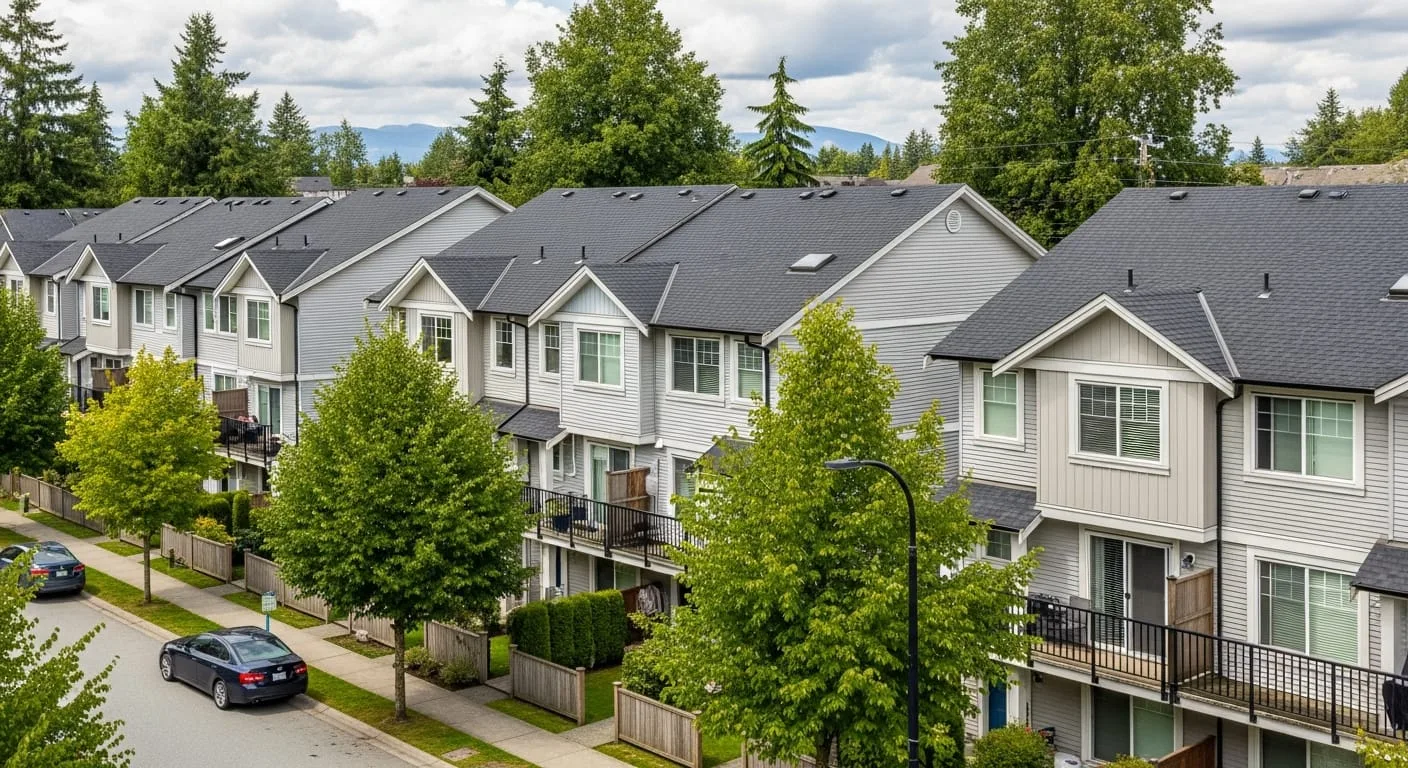
Walnut Grove, Willoughby and the broader Township of Langley were among the fastest-growing strata catchments in Metro Vancouver during the 1990s and early 2000s, and the original cedar shake and first-generation asphalt roofs from that build wave are now collectively reaching end of life. For strata councils in the catchment, the result is a high concentration of re-roof decisions arriving in the 2026 to 2030 window, often on complexes large enough that the decision has material impact on every owner's monthly assessment. This guide walks Walnut Grove and Willoughby strata councils through the full 2026 re-roof workflow specific to the Fraser Valley climate, the Township's permit process, and the operational realities of large-format Langley complexes.
Why Langley Re-Roofs Cluster in 2026 to 2030
The Walnut Grove and Willoughby townhouse build wave concentrated heavily between 1994 and 2007. Original cedar shake roofs from that era reach end of life at roughly 25 to 30 years in the Fraser Valley climate, which puts the cedar replacement wave squarely in 2019 to 2037. Original architectural asphalt shingle roofs from the same era reach end of life at roughly 22 to 28 years, putting that replacement wave at 2016 to 2035. The result is that the typical mid-1990s Langley strata complex faces a re-roof decision somewhere between today and the early 2030s, and councils that defer decisions hoping for cost relief routinely find that costs continue to rise faster than the deferral saves.
A specific complication in Langley is the high proportion of complexes that were originally built with cedar shake, over-roofed once with shingle in the 2000s, and are now leaking through both layers. Tear-off of a double-layer roof is more expensive and slower than a single-layer tear-off, and the sheathing condition underneath is often substantially worse than a single-layer roof would suggest. The 2026 cost estimates below reflect this.
Realistic 2026 Cost Ranges for Walnut Grove and Willoughby
Langley costs in 2026 are running approximately 5 to 8 percent below the Lower Mainland average for straightforward asphalt re-roofs, primarily because of easier access, cheaper material staging, and lower municipal fee structures. Where Langley costs match or exceed the regional average is on cedar-to-asphalt conversions and on double-layer tear-offs, where the labour and disposal costs are substantially higher. Per-square-foot installed costs for typical Walnut Grove and Willoughby assemblies in 2026:
- Single-layer asphalt-to-asphalt re-roof: $10.00 to $12.50 per square foot of roof area
- Single-layer cedar-to-asphalt conversion: $12.50 to $15.50 per square foot of roof area
- Double-layer tear-off (cedar plus shingle) to asphalt: $14.00 to $17.50 per square foot of roof area
- Concrete tile replacement on a higher-end complex: $22.00 to $28.00 per square foot of roof area
- Sheathing replacement allowance (recommend including in contract): $4.50 to $6.50 per square foot of replaced area
A typical 40-unit Walnut Grove townhouse complex with 32,000 square feet of total roof area facing a cedar-to-asphalt conversion is looking at a 2026 cost range of approximately $400,000 to $500,000, plus a 10 to 15 percent contingency for the sheathing allowance. Councils whose depreciation reports were written before 2023 should expect the report's allowance to come in 25 to 40 percent low against this range and should rebuild the reserve plan accordingly.
Township of Langley Permits and Process
The Township of Langley requires a building permit for any roof replacement on a stratified property, including like-for-like asphalt replacements. The application is among the most straightforward in Metro Vancouver — typical review time is 2 to 3 weeks for a complete submission — but the Township does require an engineer's letter for any change in roof assembly, including cedar-to-asphalt conversions, confirming the existing structure can carry the new load.
The Township has been active since 2023 in requiring complete waste-management plans with permit submissions, particularly for cedar shake tear-offs given the volume of disposed material. Contractors who do not have an established relationship with a Langley or Aldergrove disposal facility frequently see permit applications returned at first review for incomplete waste documentation.
Cedar-to-Asphalt Conversion: The Specific Langley Decision
More cedar-to-asphalt conversion decisions are being made in Walnut Grove and Willoughby in 2026 than in any other Metro Vancouver catchment. The math almost always favours conversion: cedar replacement runs $18 to $26 per square foot for a 30-year fire-treated cedar product against $12.50 to $15.50 for a quality architectural asphalt with a 30- to 40-year manufacturer warranty. Insurance premiums for buildings carrying cedar shake roofs have risen sharply since 2021 and several Lower Mainland insurers no longer write new policies on cedar shake at all.
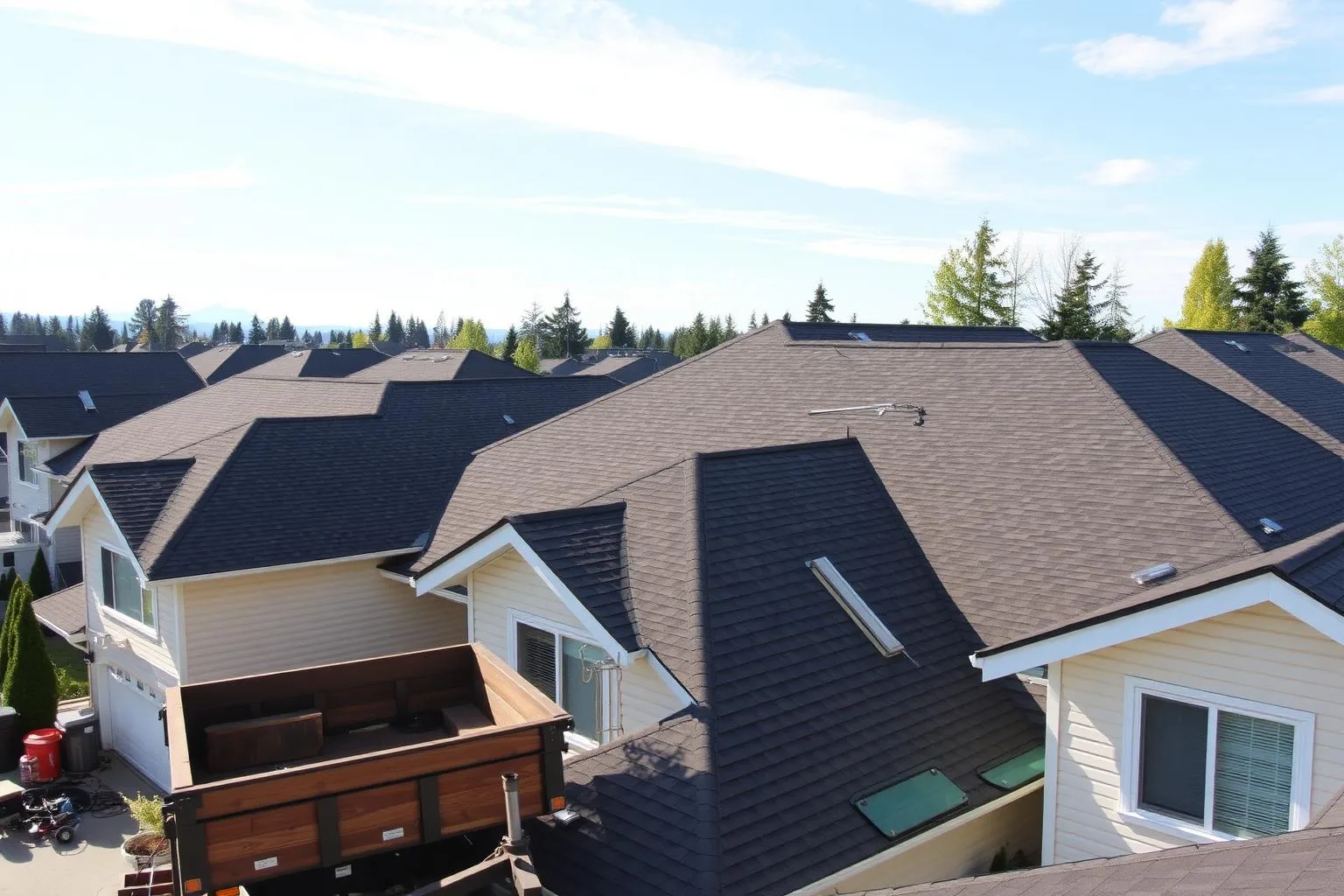
The right asphalt product for a former cedar complex is a 40-year laminated architectural shingle with Class A fire rating and a high-wind warranty. The colour selection should consider how the heavier visual weight of architectural shingle reads against the original siding and trim — sample boards at multiple times of day are worth the small upfront cost to avoid post-install owner regret.
Scheduling in the Fraser Valley Climate
The Fraser Valley climate gives Walnut Grove and Willoughby strata projects a longer practical work window than the rest of Metro Vancouver — typically April through October with reasonable confidence. Spring rainfall in the valley is less intense than on the North Shore or Burke Mountain, summer dry-day percentages are higher, and the first hard frost typically arrives later than on the mountain catchments.
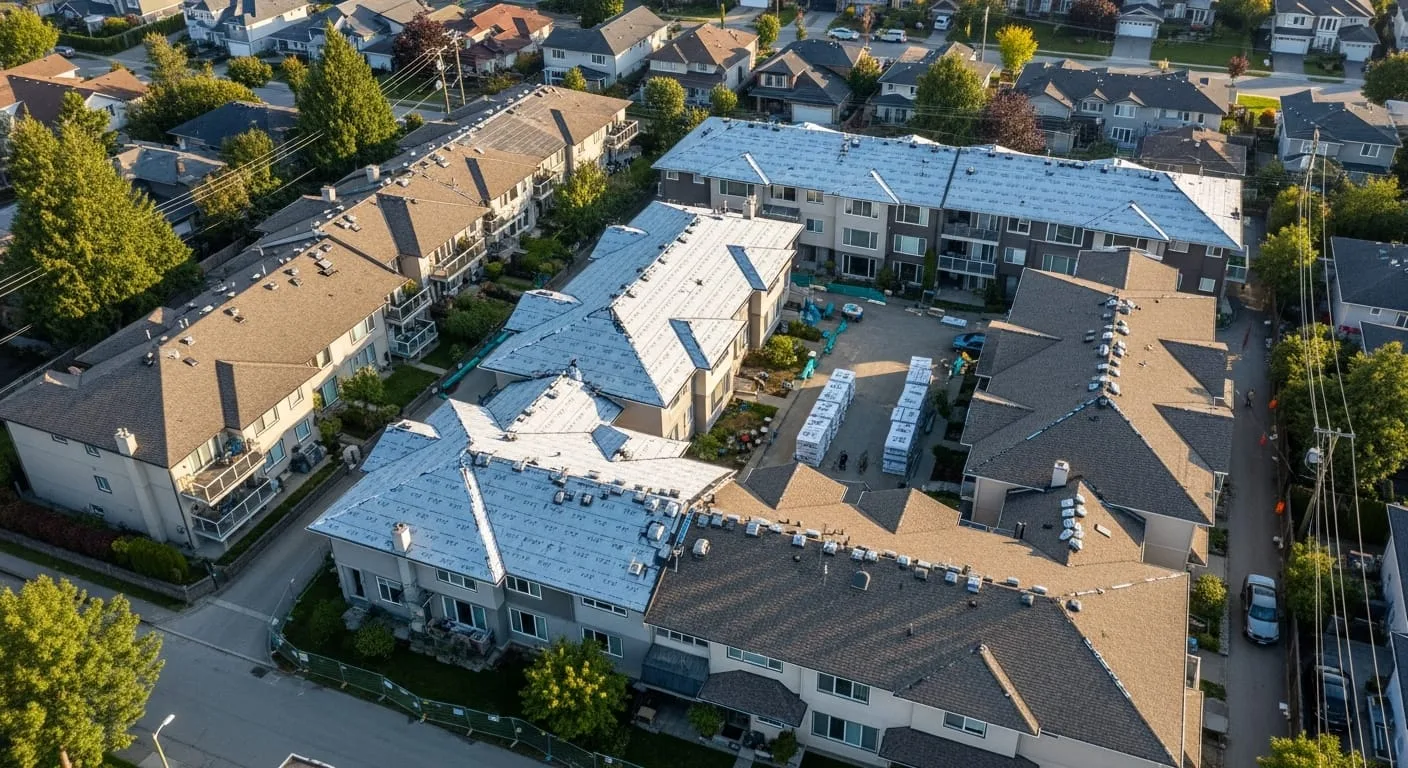
A 40-unit Walnut Grove complex typically schedules across 6 to 8 weeks of working time, broken into 4- to 6-unit clusters with a 25 percent weather contingency. Most Langley complexes can absorb the weather contingency without changing the contract close date, which makes Langley one of the more predictable catchments to deliver re-roof projects in on schedule.
Owner Communication in a Large Langley Complex
Walnut Grove and Willoughby complexes are often larger than their Vancouver and Burnaby equivalents — 40 to 80 units is common — and the owner-communication infrastructure has to scale accordingly. A single email list, a single weekly written update, and a single project phone number are the minimum. Larger complexes should add an in-person owner drop-in session every 2 weeks during active construction, hosted at the strata's amenity room with the project manager present.
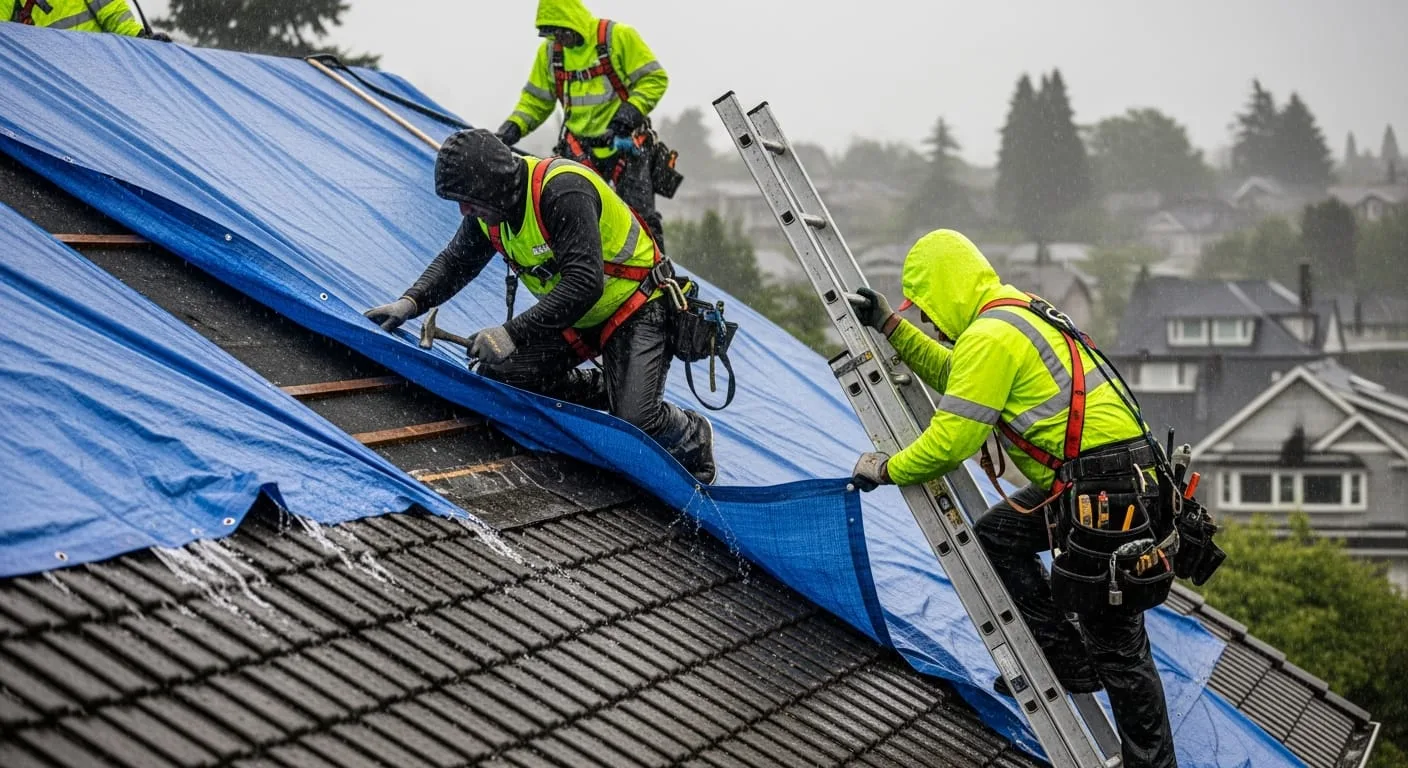
The most common communication failure on large Langley re-roofs is under-communicating during weather holds. Owners assume any pause in visible work is either contractor delay or contractor negligence. A weather-hold notice the morning of the hold, with the forecast that triggered it and the expected resumption date, prevents almost all of the complaints that otherwise drive AGM challenges to the council.
Sheathing Replacement: The Hidden Langley Cost
Cedar-era Langley townhouses frequently uncover deteriorated plywood or OSB sheathing once the cedar and shingle are removed. The 2026 contract should explicitly include a sheathing replacement allowance in the range of 5 to 15 percent of roof area, priced at $4.50 to $6.50 per square foot of replaced area. Overages above that allowance should trigger a written change order signed by the council president, not by an owner on site.
Contractors who decline to include a sheathing allowance are usually contractors who plan to bill it on a per-sheet basis during tear-off with no upper bound. That is the structure that produces unpredictable final invoices and contract disputes — and it is the single most common reason large Langley re-roof projects go over budget.
Insurance Implications of the Cedar Conversion Wave
Several Lower Mainland insurers, including a number of the larger commercial strata writers, have either non-renewed or sharply re-priced policies on cedar shake buildings since 2021. Walnut Grove and Willoughby strata councils carrying original cedar shake roofs are seeing premium increases of 25 to 60 percent at renewal, plus deductible structures that effectively transfer most wind and fire risk back onto the strata's reserve. Converting to asphalt during a re-roof typically reverses that premium trajectory at the following renewal — councils should ask their broker for a written quote on both the existing cedar continuation and the post-conversion asphalt premium before finalizing the SGM scope so that owners can see the insurance savings as part of the conversion business case.
The insurance argument frequently moves owners who are otherwise reluctant to approve the special levy. Showing that the conversion produces an immediate $200 to $600 per door per year premium reduction at the next renewal is more persuasive than any technical argument about cedar service life.
Depreciation Report Updates for Langley Councils
Walnut Grove and Willoughby depreciation reports prepared between 2014 and 2019 almost universally underestimate 2026 cedar-to-asphalt conversion costs by 30 to 50 percent. Councils planning a 2026 to 2028 conversion should commission a report update specifically including the cedar tear-off premium and the sheathing allowance before issuing any SGM notice. The update costs $1,500 to $3,500 and prevents the most common failure mode on large Langley re-roofs: an SGM vote that approves a special levy too small to actually cover the contract.
Where the updated cost exceeds the original allowance, councils should consider a combined funding approach: a special levy for the immediate gap plus a contingency reserve top-up over the following 2 to 3 years. Trying to cover the entire delta through one special levy on short notice produces owner pushback that delays the project past the optimal construction window.
Realistic Walnut Grove Re-Roof Timeline
A typical 40- to 60-unit Walnut Grove or Willoughby cedar-to-asphalt conversion in 2026 runs 9 to 13 months from first scoping call to project close. Scoping, bid solicitation, council review and SGM vote take 3 to 5 months. Permitting, engineer's letter and material lead times add 6 to 10 weeks. Construction runs 6 to 10 weeks for a 40-unit complex, 9 to 14 weeks for a 60-unit complex. Close-out, warranty registration, deficiency walk-through and final invoicing take 4 to 6 weeks.
Councils that begin scoping in the fall for the following spring or summer construction window deliver on schedule almost without exception. Councils that begin in late winter for the same summer window typically end up with compressed bid timelines, higher pricing, and reduced contractor selection — the better contractors are already booked through September by February of any given year.
Common Walnut Grove Council Mistakes to Avoid
Across more than 70 Walnut Grove and Willoughby re-roofs we have observed several recurring council mistakes. First, accepting a bid without a written sheathing replacement allowance and then watching the final invoice climb 20 to 35 percent above the contract value as deteriorated sheathing is uncovered. Second, choosing the lightest-colour shingle without on-site sample review and then dealing with a year of owner complaints about the visual change from the original cedar. Third, scheduling tear-off through the spring rain pattern hoping to finish before summer vacations, then losing weeks to weather and pushing crews into July. Fourth, allowing individual owners to negotiate timing changes directly with crews on site, which produces sequencing chaos in a 40- to 80-unit complex. Fifth, skipping the insurance broker conversation before the SGM and missing the opportunity to present premium savings as part of the conversion business case.
Each of these is preventable with a disciplined front-end process. The right contracting partner will help the council structure the contract, the communication plan, and the owner-facing business case so that the project closes on time, on budget, and with overwhelming owner support at the following AGM.
Talk to a Walnut Grove Strata Roofing Specialist
Strata Roofers BC has delivered more than 70 strata re-roofs across Walnut Grove, Willoughby, Murrayville and the broader Township of Langley since 2014, including dozens of cedar-to-asphalt conversions on large-format complexes. Fully licensed, insured and bonded with $5 million liability coverage, RCABC-member, and WorkSafeBC compliant. For a no-obligation scoping conversation including sheathing-condition forecasting, call 604-446-3482 or email admin@budgetroofers.ca.
Frequently Asked Questions
- Does the Township of Langley require a building permit for a strata re-roof?
- Yes. The Township requires a building permit for any roof replacement on a stratified property. Typical review time is 2 to 3 weeks for a complete submission with engineer's letter and waste-management plan.
- What does a 40-unit Walnut Grove cedar-to-asphalt conversion cost in 2026?
- Approximately $400,000 to $500,000 for 32,000 square feet of roof area, plus a 10 to 15 percent contingency for sheathing replacement. Double-layer tear-offs run roughly 12 to 18 percent higher than single-layer.
- Should our Langley council still consider replacing with cedar instead of converting to asphalt?
- Almost never in 2026. Cedar costs 50 to 80 percent more installed than equivalent architectural asphalt, and several insurers no longer write new policies on cedar shake at all in the Fraser Valley.
- What is the practical re-roof window in Walnut Grove and Willoughby?
- April through October with reasonable confidence. The Fraser Valley climate offers a longer practical work window than the North Shore or Burke Mountain, with higher summer dry-day percentages and a later first frost.
- Why does our contract need a sheathing replacement allowance?
- Cedar-era Langley townhouses frequently uncover deteriorated plywood or OSB once the existing roof is removed. An upfront allowance with a clear per-square-foot price and a written change-order process for overages prevents the contract disputes that otherwise drive cost overruns.
Need a free assessment?
Licensed · Insured · Bonded roofing across Metro Vancouver.