Managing a Townhouse Complex Re-Roof Project in BC: A Council Playbook
Published May 17, 2026 · Updated May 17, 2026
A 40-unit townhouse re-roof is one of the most operationally complex projects a BC strata council will oversee. It is half construction and half communication, and the communication half is what determines whether the project closes on time, on budget, and without a complaint storm at the next AGM. This playbook is the workflow our project managers actually run on Metro Vancouver townhouse complexes — adapt it to your council and your contractor.
Phase 1: Pre-Construction (12–16 Weeks Before Tear-Off)
Lock the scope in writing
Before any AGM vote on funding, the council and contractor agree to a single written scope document: membrane or shingle product and manufacturer, all flashing details, ventilation upgrades, sheathing repair allowance per unit, gutter and downspout work, skylight handling, and warranty registration. Every council member receives the same document. Every owner can request it. Vague scope is the root cause of more than 80% of late-project disputes.
Set the construction calendar with weather contingency
Metro Vancouver re-roofs are best scheduled May through September when the dry-day percentage is highest. A 40-unit complex typically schedules 4–6 weeks of working time, plus a 30% weather contingency built into the calendar. Avoid scheduling the final unit cluster against a hard deadline like an owner's pre-listed sale closing — weather will eventually push schedule.
Pre-construction owner meeting
Hold one in-person or video meeting for all owners 6–8 weeks before tear-off begins. The contractor's project manager attends and answers questions directly. Topics: schedule, daily hours, noise, dust, parking, pet safety, satellite dishes, balcony plants, garbage day handling, complaint escalation contact, change-order process. Distribute a written FAQ summarizing the meeting.
Phase 2: Communication Infrastructure
Set up four channels and use them consistently throughout the project:
- Master schedule — published weekly, showing which unit cluster is in tear-off, in-progress, or weather-hold
- Individual unit notices — 14-day, 7-day, and 24-hour notices for each owner
- Daily site board — a physical whiteboard at the construction trailer showing today's plan and tomorrow's plan
- Single contact — one email and one phone number for all owner questions, monitored Monday through Saturday
The single contact rule matters more than people expect. If owners can reach the contractor directly, the contractor and the strata receive conflicting messages, scope creeps, and disputes follow. Route everything through one channel staffed by the project manager.
Phase 3: Construction Sequencing
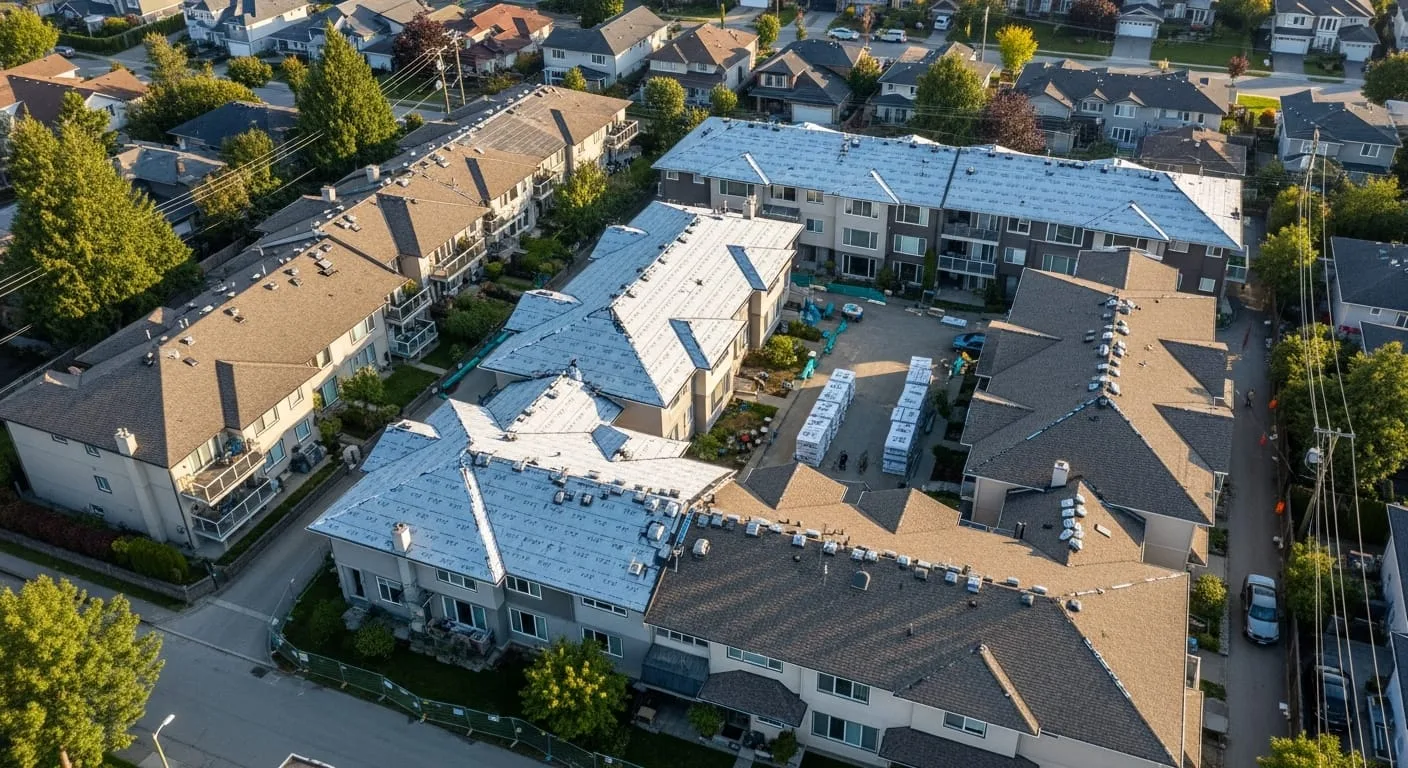
Sequence the complex in 4–6 unit clusters rather than running the whole site at once. Cluster sequencing has three operational advantages: weather impact is contained, scaffolding and crane positioning is efficient, and any one owner is only directly impacted for 3–5 days rather than 4–6 weeks.
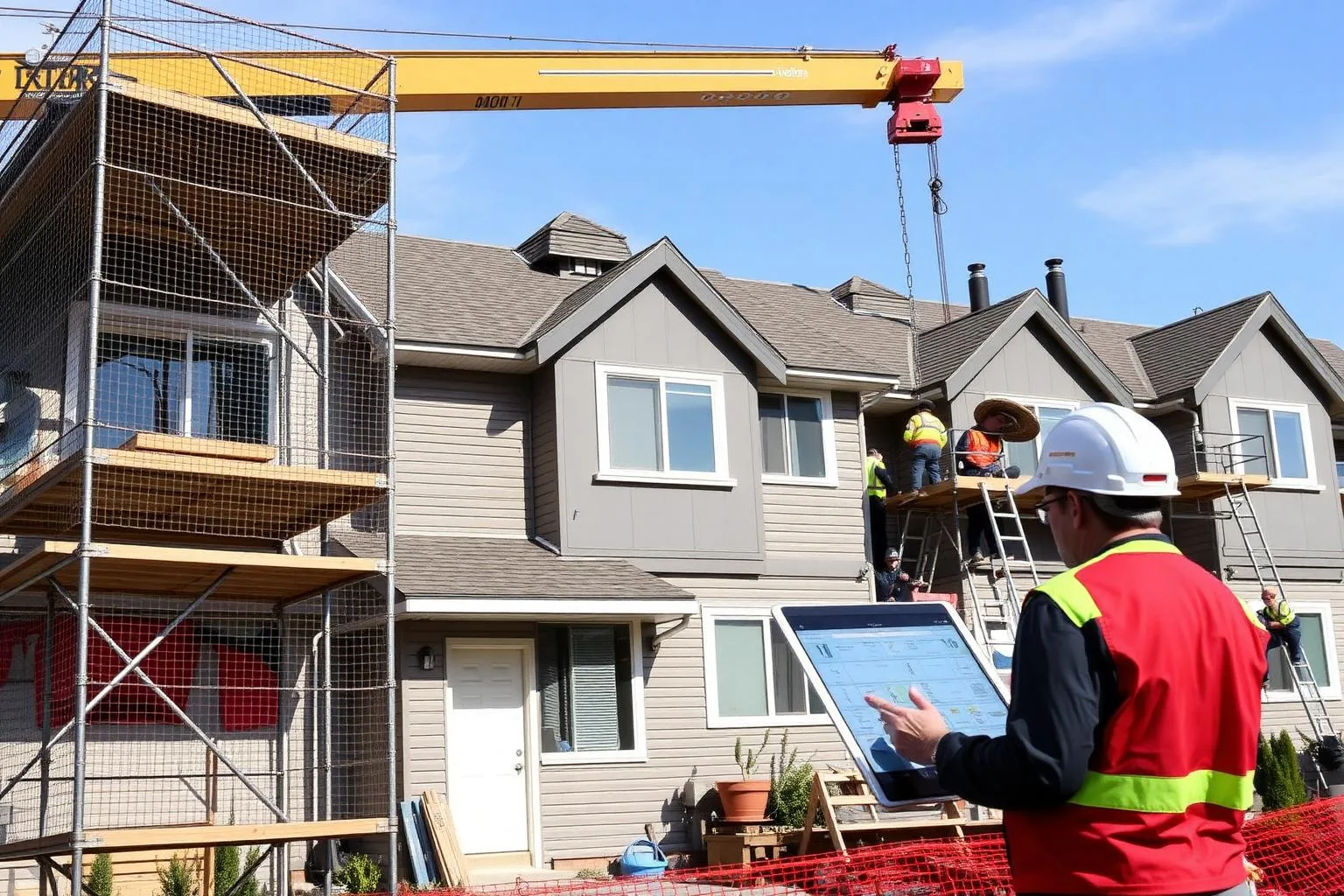
Each cluster runs through the same workflow: scaffold and safety netting (day 0), tear-off and sheathing inspection (day 1–2), sheathing repair and underlayment (day 2–3), shingle or membrane install (day 3–5), flashing, ridge, gutter reconnect (day 5–6), final inspection and scaffold removal (day 6–7). Then the crew moves to the next cluster while the prior cluster is independently inspected by the RCABC inspector if applicable.
Phase 4: Weather and Schedule Management
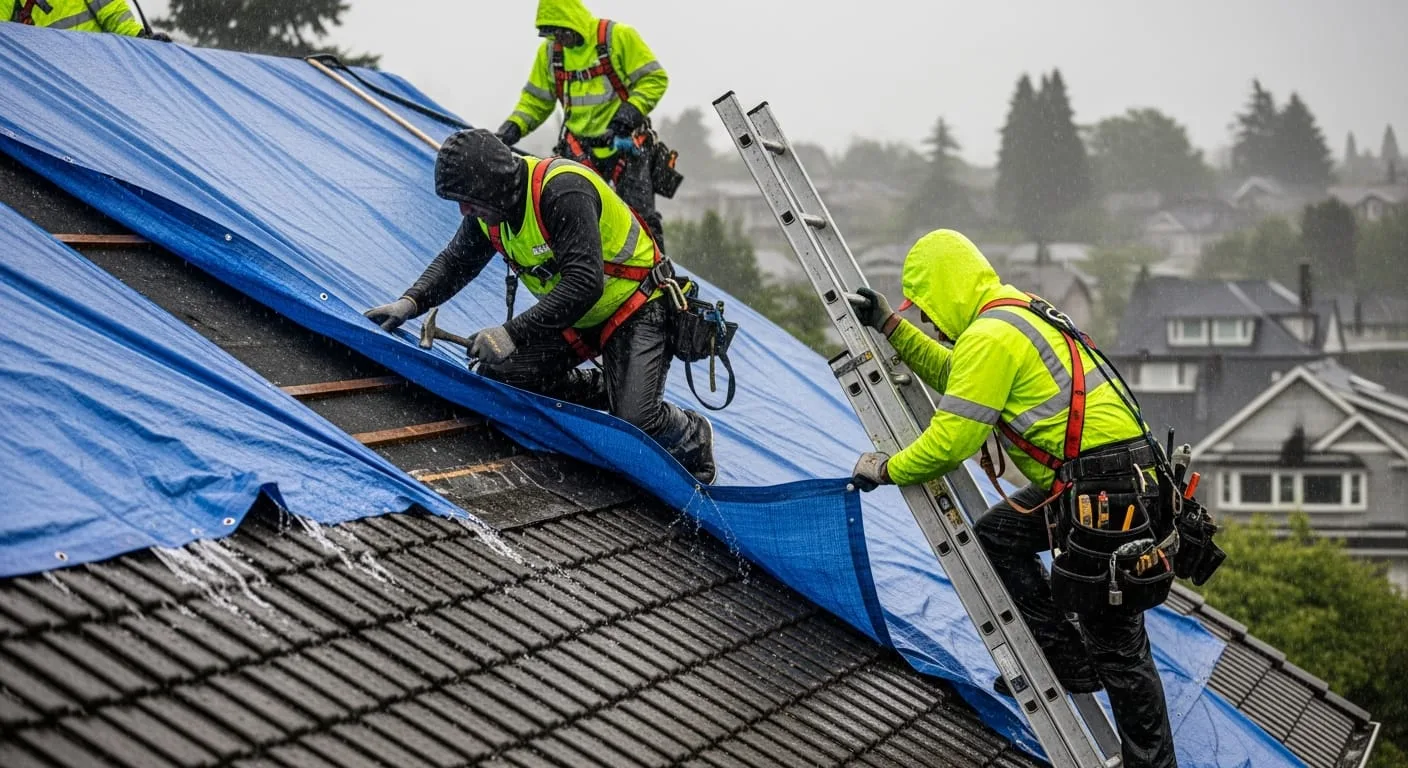
Rain delays are not a contractor failure — they are a weather reality in the Lower Mainland. The project manager pulls hourly forecasts the day prior and makes a tear-off go/no-go call by 5 a.m. the morning of. The communication rule is simple: if a delay affects an individual owner's notice window, they get a personal phone call before 8 a.m. that morning, not a group email at noon.
Build the calendar with a 30% weather contingency from the start. If you do not need it, the project closes early and owners are delighted. If you do need it, you absorb it without a contract amendment or angry email thread.
Phase 5: Change Orders and the Sheathing Allowance
The most common source of mid-project cost surprise is sheathing replacement. Cedar-era and 1980s townhouses frequently uncover deteriorated plywood or OSB once the membrane is removed. The scope must include a per-square-foot allowance for sheathing replacement, with overage triggering a written change order signed by the council president or designated signing authority — never by an owner.
All change orders should be issued within 24 hours of the trigger event, in writing, with photo documentation. A council that approves change orders by group email thread on the weekend is a council that loses control of project cost.
Phase 6: Quality Hold Points
Insert four explicit hold points where work stops until council or council's representative signs off:
- Post-tear-off, pre-underlayment — sheathing condition and deck repair scope confirmed
- Post-underlayment, pre-shingle — ice-and-water shield, valley membrane, drip edge confirmed
- Post-shingle, pre-flashing — installation pattern and nail pattern confirmed
- Pre-demobilization — final walk-through with photo report and warranty paperwork
Hold points add half a day per cluster but eliminate almost all post-project warranty disputes. The contractor cannot later argue that you accepted hidden work you never saw.
Phase 7: Hand-Off, Warranty, and Maintenance Plan
At project close the contractor delivers a project binder containing: as-built scope, manufacturer warranty registration with the strata named as the warranty holder, RCABC Guarantee certificate if applicable, third-party inspector's report, photo log of all four hold points, change order log, and the recommended annual maintenance schedule.
Schedule the first annual maintenance visit for 11 months after substantial completion — before the workmanship warranty year expires. Catching minor punch-list issues during that visit keeps them under warranty rather than under the strata's operating budget.
Owner Experience: The Quiet Metric That Decides Re-Election
Councils that deliver a re-roof on schedule and on budget but generate 40+ owner complaints during construction frequently face challenger slates at the next AGM. Councils that deliver the same project with 3–5 complaints get re-elected unanimously. The difference is almost always the communication infrastructure in Phase 2, not the construction itself.
Owners do not expect a re-roof to be silent or invisible. They expect to be told what is happening, when, and what to do about their car, their dog, and their satellite dish. Meet that expectation and the project becomes a council win.
Talk to a Project Manager
Strata Roofers BC has delivered more than 120 multi-unit townhouse re-roofs across Metro Vancouver under this playbook. For a no-obligation pre-construction scoping conversation, call 604-446-3482 or email admin@budgetroofers.ca.
Frequently Asked Questions
- How long does a 40-unit townhouse re-roof take in Metro Vancouver?
- Approximately 4–6 weeks of actual construction time, scheduled in 4–6 unit clusters with a 30% weather contingency built into the calendar. Each individual owner is directly impacted for 3–5 days.
- What is the best time of year to re-roof a townhouse complex in BC?
- May through September, when dry-day percentages are highest in the Lower Mainland. October through March projects are possible but require larger weather contingencies and tighter daily forecasting.
- Who should owners contact with questions during the project?
- One designated single point of contact at the contractor, monitored Monday through Saturday. Avoid routing owners directly to crews or trades on site — it creates conflicting messages and scope creep.
- How should change orders be approved during construction?
- In writing, within 24 hours of the trigger event, with photo documentation, signed by the council president or designated signing authority. Never approve change orders by group email thread or by individual owners on site.
- What is a sheathing allowance and why does the contract need one?
- A per-square-foot dollar amount built into the contract to cover replacement of deteriorated plywood or OSB sheathing discovered during tear-off. Overages above the allowance trigger a written change order. Without an allowance, every sheathing surprise becomes a contract dispute.
- When should we schedule the first post-project maintenance visit?
- Eleven months after substantial completion, before the workmanship warranty year expires. This lets any minor punch-list items be caught and corrected under warranty rather than at the strata's expense.
Need a free assessment?
Licensed · Insured · Bonded roofing across Metro Vancouver.