Council Governance

Quality Roofing at Competitive Pricing: How BC Strata Councils Get Both

Lowest bid and best value are not the same thing. Here is how BC strata councils get quality workmanship at genuinely competitive pricing — without trading warranty, fire-watch compliance, or service life for a smaller line item.

May 16, 2026 12 min readBy Strata Roofers Team
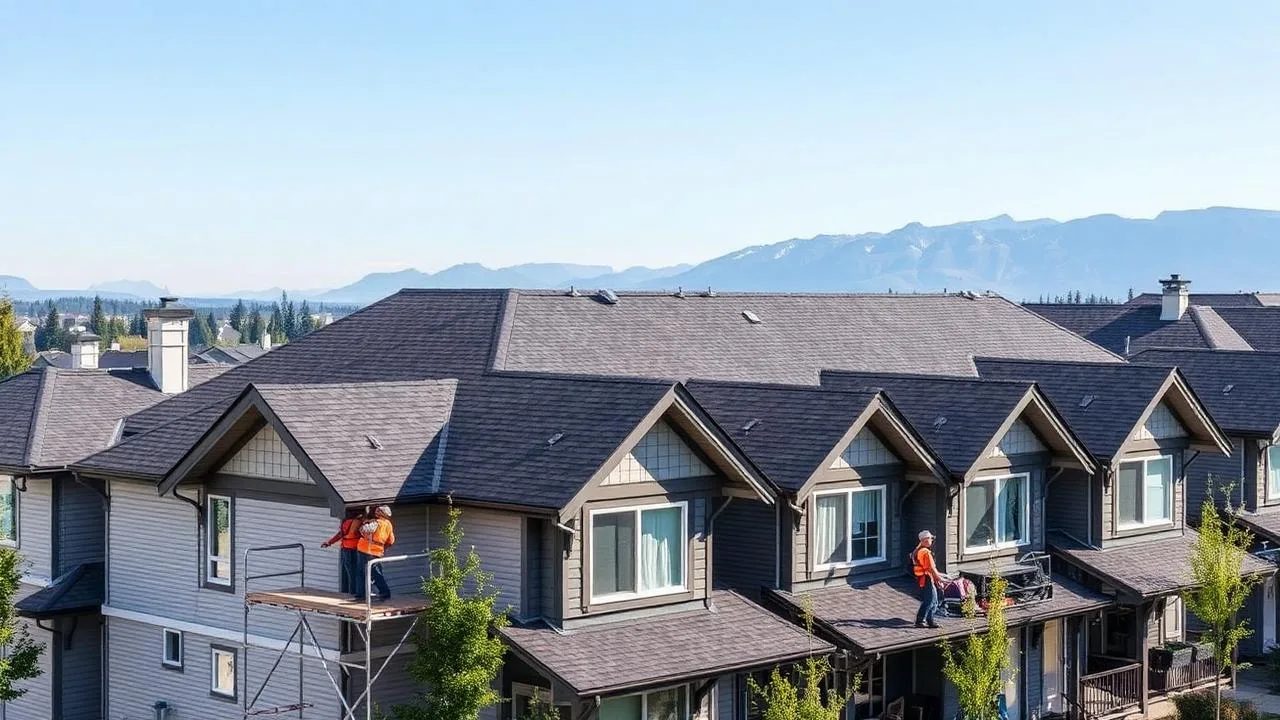
Two roofers in green shirts installing premium asphalt shingles on a multifamily strata building rooftop in British Columbia under a clear blue sky, with organized material bundles and a ladder staged for safe access

Why "cheapest quote" is the most expensive mistake a council can make

Every strata council in British Columbia eventually faces the same moment: three quotes on the boardroom table, one notably lower than the other two, and an owner asking "why aren't we just taking the cheap one?" The honest answer is that on a strata roofing project, the spread between bids is almost never a pricing inefficiency the council gets to capture. It is a scope difference, a warranty difference, or a workmanship-grade difference — and the council pays for that difference later, usually in the form of premature failure, voided warranties, or insurance complications no one anticipated.

That doesn't mean councils have to overpay. It means the goal should not be "lowest number" — it should be "lowest honest number for the right scope." Done correctly, the spread between a quality contractor priced competitively and a cut-rate contractor priced cheaply is usually 8–15%, not the 40–60% that makes councils nervous. When you see a 40% spread, the cheap bid is almost certainly missing something material.

What "competitive pricing" actually means on a strata roof

Competitive pricing is not a number — it is a relationship between price, scope, and risk. A genuinely competitive quote on a BC strata roof has three properties:

  1. It is line-itemed. Tear-off, substrate repair allowance, underlayment, primary roofing material, flashings, drains, dump fees, permits, fire watch, and warranty registration each appear on their own line. A single lump-sum number cannot be compared honestly to anything.
  2. It is specified. The quote names the actual product (manufacturer + product line + warranty tier), the actual standard (CRCA, RCABC, manufacturer NDL), and the actual crew certifications (Red Seal, RCABC-member, RoofStar-eligible).
  3. It is honest about contingency. Substrate condition under a 20-year-old roof is unknowable until tear-off. A bid that pretends otherwise is either uninformed or planning to surprise the council with a change order after demolition begins.

The team at BudgetRoofing.ca publishes quotes with all three of these properties as a default. That is not a marketing pose — it is the only way a council can defend the award decision at an AGM and answer the owner who wants to know why bid #2 was selected over bid #3.

The real cost drivers (and where contractors actually save money)

Once you understand what drives the cost of a strata reroof, it becomes obvious where a contractor can save the council money honestly — and where they can only save by cutting corners. The major cost drivers in a typical BC strata roofing project, ranked by share of total cost:

  • Material (35–45%) — shingles, membrane, underlayment, insulation, flashings, fasteners. Bulk-buying relationships with manufacturers can save 5–10% on this line. There is no honest way to save more without dropping warranty tier.
  • Labour (25–35%) — crew time on the roof. Skilled crews work faster, not slower, so paying for Red Seal labour usually costs less per square installed than a cut-rate crew that has to redo work.
  • Overhead (10–20%) — office staff, marketing, financing costs, sales commissions. This is where the largest honest savings live. A lean operation can run 8–12% overhead where a national franchise might run 22–28%.
  • Disposal, permits, mobilization (5–10%) — largely fixed regional costs. Hard to compress without breaking rules.
  • Profit (8–15%) — what the contractor actually takes home. Below 8% the business is not sustainable; above 15% the council is funding someone's expansion.

This is why a focused, low-overhead operation like BudgetRoofing.ca can quote 10–15% under a national franchise without dropping a single line of specification: the savings come from a lean back office, not a thin install.

Where cut-rate quotes hide the savings

When a bid comes in 30–50% under the field, the savings are almost always hidden in one or more of these places. Council reviewers should check each of them before accepting any low bid:

  • Fire-watch hours. SBS torch-on work requires a dedicated fire watch and a 30-minute post-torch monitoring period under CRCA hot-work protocols. Cut-rate crews silently drop one or both. See our breakdown in SBS torch-on installation standards.
  • Flashing detail grade. A "complete flashing package" might mean continuous step + counter-flashing, or it might mean a bead of sealant. The difference is 15–20 years of service life. See our piece on wall and counter-flashing details.
  • Warranty tier. Manufacturers offer a base warranty (often covers material only) and a premium NDL warranty (covers labour, installation, and resultant damage). Cut-rate quotes typically default to base. See manufacturer NDL warranties for strata.
  • Substrate allowance. No allowance means a change order at tear-off. A typical honest allowance is 5–10% of project value.
  • Permits and dump fees. Listed separately and accurately, or quietly assumed away.
  • WorkSafeBC and liability coverage. The cheapest crew on the market is often the one without proper coverage. The strata corporation inherits the liability the moment the contractor sets foot on the roof.

How to write a tender that produces honest, competitive bids

The single biggest lever a council has on pricing is the tender document itself. A vague RFP gets vague quotes, and vague quotes cannot be compared. A tight tender produces tight, comparable bids — and the spread between them collapses dramatically. Our recommended structure:

  1. State the assembly explicitly. "Two-ply SBS torch-on per CRCA specification, with manufacturer X NDL warranty" — not "new flat roof."
  2. Mandate line-item pricing. Provide a template with the cost categories above. Reject lump-sum bids.
  3. Require certifications up front. RCABC membership, Red Seal certification of foreman, WorkSafeBC clearance, $5M liability minimum.
  4. Define the substrate contingency model. "Unit price for substrate sheathing replacement: $___ per 4x8 sheet, applied only to areas documented during tear-off with photo + measurement."
  5. Specify the warranty deliverables. Manufacturer warranty registration certificate, RCABC RoofStar guarantee (if applicable), workmanship warranty terms in writing.
  6. Set a fixed bid format and deadline. Bids received outside the format don't get scored.

If you'd like a sample tender document tuned to BC strata work, both our depreciation report inspection deliverable and the quoting team at BudgetRoofing.ca can provide one. The point is to make the bids honest before you read them — not to figure out which one is dishonest after the fact.

What 2026 BC strata roofing pricing actually looks like

Current market rates for the most common BC strata assemblies, mid-range competitive pricing for a properly specified job:

  • Architectural asphalt shingles (pitched townhouse) — $7.50–$10.50 per square foot installed, including tear-off, ice & water shield in valleys, synthetic underlayment, ridge vent, and manufacturer warranty registration.
  • Two-ply SBS torch-on (low-slope strata) — $16–$24 per square foot installed, including tear-off to deck, vapour barrier, insulation, base + cap sheet, all flashings, and CRCA-compliant fire watch.
  • TPO single-ply membrane (large flat roof) — $14–$22 per square foot installed, depending on attachment method (mechanically fastened vs. fully adhered) and warranty tier (15-year vs. 20-year NDL).
  • Modified bitumen repair / patch — $35–$65 per square foot for small targeted repairs, including detail flashing and 5-year workmanship warranty.

If you receive a quote significantly below the bottom of these ranges, the most likely explanation is missing scope, not a bargain. A quote significantly above usually reflects either unusual access/complexity or franchise overhead. The BudgetRoofing.ca price sheet sits right in the middle of these ranges by design — competitive without being suspicious.

Total cost of ownership beats sticker price every time

The honest measure of a roof's cost is dollars per year of reliable service life. A $180,000 reroof that lasts 25 years costs $7,200 per year. A $140,000 reroof from a cut-rate crew that needs major repair at year 12 and full replacement at year 18 costs $7,800–$9,000 per year once you add up the patch jobs, the early replacement, the insurance deductibles paid along the way, and the loss of warranty leverage when something goes wrong. The "expensive" quote was actually cheaper.

This is the math councils should run on every bid. It's not complicated, and it changes the decision more often than any other single analysis. Our 25-year insurance window Q&A walks through how this same logic interacts with insurance underwriting — another reason cheap-and-short loses to right-priced-and-long.

Red flags in a "too good to be true" quote

  • No line items, only a single lump sum.
  • No manufacturer or product specified by name.
  • No RCABC membership, no Red Seal foreman named, no WorkSafeBC clearance number on file.
  • "Lifetime warranty" with no underwriter named.
  • Deposit demand above 15% of project value.
  • Pressure to sign within 48 hours of receiving the quote.
  • No physical office address you can drive to.
  • No reference list of completed BC strata projects.

Any one of these is a yellow flag. Two or more is a red flag and the bid should be set aside regardless of price.

Green flags in a competitively-priced quote from a quality contractor

  • Line-itemed scope matching the tender categories.
  • Named products with warranty tier identified.
  • Named foreman with Red Seal number, RCABC membership confirmed.
  • Photo-supported pre-bid inspection.
  • Realistic substrate-repair unit pricing.
  • Written fire-watch and hot-work plan attached.
  • Reference list of comparable BC strata buildings within the last 24 months.
  • Standard deposit terms (10–15% on signing, balance on milestones).
  • Council-ready presentation package suitable for AGM circulation.

This is the bid format the team at BudgetRoofing.ca produces by default. The pricing is competitive because the overhead is lean and the operation is focused — not because anything has been trimmed from the install. Councils get a quote they can defend, scope they can compare, and a number that respects the CRF without inviting trouble.

How to compare three honest bids

Once you have three properly-structured quotes in hand, comparison is straightforward. Build a single spreadsheet with these columns: scope item, bid 1, bid 2, bid 3, notes. Walk down the list line by line. Where bids agree within 5%, that line is a fair-market number. Where one bid is materially lower, ask the contractor specifically what is included on that line. Where one bid is materially higher, ask what extra value justifies it. Within two hours of disciplined comparison, the right choice is usually obvious — and it is almost never the absolute lowest number, but it is almost never the highest either. It's the bid that prices honestly across every line.

Where to start

If your council is approaching a reroof decision, the right sequence is: (1) get an independent inspection — we offer this as part of our depreciation report inspection service; (2) use the inspection to write a tight tender; (3) request line-item quotes from 3 qualified contractors; (4) compare line by line; (5) award on best honest value, not lowest number.

For a competitively-priced quote on quality strata roofing work, our partners at BudgetRoofing.ca specialize in exactly this brief — quality workmanship, lean overhead, line-itemed quoting, council-ready presentation. You can request a quote from BudgetRoofing.ca directly, or request one through us and we will route to the right team for your building. Either way, you'll get a bid you can defend at AGM and a roof that earns its price every year it's on the building.

Service area

Competitive strata roofing pricing is available across Metro Vancouver and the Fraser Valley. For city-specific notes see Vancouver, Burnaby, Surrey, Coquitlam, Richmond, and our full service area.

Case study: a 32-unit Coquitlam townhouse complex

A 32-unit townhouse strata in Coquitlam received three quotes for a full asphalt-shingle reroof in spring 2025. Bid A came in at $412,000 from a national franchise. Bid B came in at $268,000 from an unfamiliar contractor with no BC strata references. Bid C, from a competitively-priced quality contractor in the model of BudgetRoofing.ca, came in at $341,000. On first glance, Bid B looked like an obvious win — it was $73,000 below the next quote and $144,000 below the highest. Owners pushed council hard to take it.

Council instead requested line-item breakdowns from all three. Bid A's $412,000 included $58,000 of franchise overhead and a $22,000 sales commission that added no value to the install. Bid B's $268,000 quietly assumed reuse of existing underlayment, omitted ice & water shield in valleys, used a builder-grade 3-tab shingle (not the architectural shingle specified in the tender), and offered only a 5-year workmanship warranty. Bid C's $341,000 line-itemed to architectural shingles, full new underlayment with valley ice & water shield, ridge vent, RCABC-member install crew, and a 15-year workmanship warranty backed by manufacturer NDL. Once normalized to the tender scope, Bid B would have been approximately $338,000 — within $3,000 of Bid C. Council awarded to Bid C, the work finished on time and on budget, and the inspection report at year 1 came back clean.

The lesson is not that low bids are always bad. It is that low bids are usually low for a reason, and the council's job is to find that reason before the contract is signed — not after the demo crew is on site.

The role of the property manager in keeping pricing honest

A good property manager is the council's first defense against pricing games. They see hundreds of quotes per year across their portfolio and develop an intuition for what a fair number looks like in each assembly category. When a quote lands outside the expected range — high or low — a good PM flags it for council and explains why. A great PM also maintains a vetted vendor list of contractors who consistently quote honestly, and they will steer council toward a competitive RFP rather than a single-source negotiation.

If your property manager is not playing this role, that is itself a flag worth addressing. The strata corporation pays the PM for fiduciary judgment on exactly this kind of decision, and a passive PM who simply forwards whatever contractor walks in the door is leaving real value on the table. Our team works directly with PMs across the Lower Mainland to deliver the kind of council-ready quote packages that make this easier; BudgetRoofing.ca does the same.

Financing competitive quotes without a special levy

One of the underrated reasons councils chase low bids is the fear of needing a special levy. But a special levy is not the only path. Three financing models can deliver a quality, competitively-priced reroof without the AGM fight:

  • CRF draw with phased work. If the roof can be staged across two budget years without compromising service life, splitting the project allows full payment from the contingency reserve fund.
  • CRF top-up over 2–3 years before the work. When the depreciation report flags the roof at year 22, a council that starts topping up the CRF immediately can usually pay cash by year 25.
  • Strata corporation loan. Available through specialty lenders at rates that compare favorably with credit cards or unsecured personal borrowing by owners. Spreads the cost across the service life of the asset, which is the financially correct way to fund a long-lived capital improvement.

The honest pricing matters in every one of these models. A quote that's $40,000 too high distorts the CRF draw schedule, the top-up math, and the loan size. A quote that's $40,000 too low under-funds the project and triggers an emergency special levy mid-project — the worst possible outcome for owner relations. Competitive, accurate pricing is the foundation under all three financing paths.

Frequently asked questions about competitive strata roofing pricing

Is the cheapest bid ever the right choice?

Occasionally, yes — when the cheapest bid comes from a focused, lean operation with full credentials and a line-itemed scope that genuinely matches the tender. When the cheapest bid is cheap because something is missing, no. The test is line-by-line comparison, not gut feel.

How many quotes should we get?

Three is standard. Two is too few for honest comparison; four or more produces diminishing returns and slows the decision. Aim for one national-scale contractor, one mid-market specialist, and one lean local operation — three different overhead models produce three meaningfully different numbers and reveal the true market rate.

Should we use a roofing consultant?

For projects over $250,000, yes. A consultant fee of $4,000–$12,000 typically saves 5–15× that amount through better tender specification and bid evaluation. For smaller projects, a written inspection report and a tight tender template are usually sufficient.

How long should a quote be valid?

30 days is standard. Material costs can move 3–5% in a 90-day window, so longer validity periods either build a cost cushion into the quote (raising the price) or expose the contractor to margin risk (lowering quote quality). 30 days respects both sides.

What deposit should we expect?

10–15% on contract signing is normal. 25%+ should be questioned. Any quote requiring 50%+ up front is a cash-flow warning sign about the contractor itself.

Can we negotiate after receiving quotes?

Yes, but carefully. Asking the preferred contractor to sharpen their pencil by 3–5% is normal. Asking them to match the lowest bid on a non-comparable scope produces either a corner-cut install or a withdrawn quote. Negotiate on terms (schedule, deposit, warranty) before you negotiate on price.

Get a competitive quote today

If your council is ready to compare honest, line-itemed quotes for quality strata roofing work at genuinely competitive pricing, the fastest path is to contact BudgetRoofing.ca for a quote tuned to council-ready evaluation, or request a quote through Strata Roofers and we will coordinate with the right team for your building, assembly, and timeline. Either way, you'll receive a quote built around the principles in this article: line-itemed, fully specified, properly credentialed, honestly contingent — and priced to win on value, not on hidden corners.

Frequently asked questions

What is a competitive price for a BC strata reroof in 2026?
Architectural asphalt shingles run $7.50–$10.50 per square foot installed, two-ply SBS torch-on $16–$24, and TPO single-ply $14–$22 per square foot installed. Quotes significantly below these ranges almost always have scope missing — fire watch, flashing detail, warranty tier, or substrate allowance.
Is the cheapest roofing bid ever the right choice for a strata?
Occasionally yes, when the cheapest bid comes from a focused, lean operation with full RCABC and Red Seal credentials and a line-itemed scope that matches the tender exactly. When the bid is cheap because something is missing, no. The test is line-by-line comparison, not gut feel.
How many roofing quotes should a BC strata council collect?
Three is standard. Two is too few for honest comparison and four or more produces diminishing returns. Aim for one national-scale contractor, one mid-market specialist, and one lean local operation — three different overhead models reveal the true market rate.
What deposit is normal on a strata roofing contract?
10–15% on signing is standard. 25% or more should be questioned. Any quote requiring 50% or more up front is a cash-flow warning sign about the contractor itself.
How long should a roofing quote stay valid?
Thirty days is standard. Material costs can move 3–5% in a 90-day window, so longer validity periods either build a cost cushion into the price or expose the contractor to margin risk. Thirty days respects both sides.
Should our strata hire a roofing consultant?
For projects over $250,000, yes. A consultant fee of $4,000–$12,000 typically saves 5–15× that amount through tighter tender specification and disciplined bid evaluation. For smaller projects, a written inspection report and a tight tender template are usually sufficient.
Can we negotiate after receiving roofing quotes?
Yes, but carefully. Asking the preferred contractor to sharpen pricing by 3–5% is normal. Asking them to match the lowest bid on a non-comparable scope produces either a corner-cut install or a withdrawn quote. Negotiate on terms — schedule, deposit, warranty — before negotiating on price.
What credentials should a strata roofing contractor have in BC?
RCABC membership, Red Seal certified foreman, current WorkSafeBC clearance, $5M+ liability insurance, a physical office address, and a reference list of BC strata projects completed in the last 24 months. Missing any of these is a yellow flag; missing two or more is a red flag.
How do we fund a quality reroof without a special levy?
Three paths: phased work across two budget years paid from the CRF, a 2–3 year CRF top-up before the work begins, or a strata corporation loan from a specialty lender. Each spreads cost without an emergency assessment, and each depends on having an honest quote to plan against.
Where can we request a competitively priced strata roofing quote?
Contact BudgetRoofing.ca at https://budgetroofing.ca for line-itemed quotes built for council-ready evaluation, or request a quote through Strata Roofers and we will route to the right team for your building, assembly, and timeline.
What is the average cost to replace a strata roof in BC?
For a typical 20–40 unit Lower Mainland strata, full reroof budgets land between $180,000 and $650,000 depending on assembly. Pitched asphalt shingle townhouse complexes average $9 per square foot installed, SBS torch-on low-slope roofs $18–$22, and TPO single-ply $16–$20. Always budget a 10% substrate contingency on top of the headline number.
How long does a strata roof replacement take from quote to completion?
Plan on 6–9 months end-to-end: 4–8 weeks for inspection and tender, 2–4 weeks for bid evaluation and council vote, 4–8 weeks for special-levy or CRF processing if needed, 6–12 weeks for permit and material lead time, then 2–6 weeks of on-roof work depending on building size. Starting the conversation in year 22–23 of a 25-year roof is the right pace.
Do strata roofing projects in BC require a building permit?
Like-for-like reroofs of pitched residential roofs typically do not require a permit in most BC municipalities, but any change in assembly (shingle to metal, BUR to TPO), structural deck repair, or work touching firewalls almost always does. Vancouver, Burnaby, and Surrey each have slightly different thresholds — confirm with your municipal building department or have the contractor pull the permit and itemize the fee.
What is RCABC RoofStar and why does it matter for strata roofs?
The Roofing Contractors Association of British Columbia (RCABC) RoofStar Guarantee is an independent, third-party warranty issued only when an RCABC-member contractor installs to RCABC Roofing Practices Manual standards with documented inspections. For strata buildings it matters because the guarantee survives contractor insolvency, transfers with the building, and is the strongest warranty defense available against premature failure claims.
Can our strata replace just part of the roof to save money?
Partial reroofs work when the assembly is sectional (independent townhouse units) and the remaining sections still have 5+ years of life. They rarely work on continuous low-slope roofs because new and old membranes age differently and the tie-in seam becomes a chronic leak point. A roofing professional should walk the roof and give you a written staging recommendation before council assumes phasing is viable.
How does roof age affect BC strata insurance renewals?
Most BC strata insurers treat 25 years as a soft ceiling. Past that, councils commonly see water-damage deductibles jump from $25,000 to $100,000+, premium surcharges of 20–80%, exclusions on resultant damage, or outright non-renewal. A documented inspection and a funded replacement plan in the depreciation report are the strongest defenses at renewal time.
What is the difference between SBS torch-on and TPO for strata roofs?
SBS torch-on is a two-ply modified bitumen membrane, heat-welded on site — proven, repairable, and the BC default for 30+ years, but requires CRCA fire-watch protocols. TPO is a single-ply thermoplastic membrane, mechanically fastened or fully adhered, with no open flame, cooler surface temperature, and good fit for solar-ready roofs. Both deliver 20–25 year service life when installed to specification.
Who pays for a strata roof replacement — owners or the corporation?
The strata corporation pays from common funds. In practice that means the contingency reserve fund (CRF) first, a special levy assessed to all owners by unit entitlement if the CRF is insufficient, or a strata corporation loan repaid through future strata fees. Owners do not pay contractors directly; the corporation contracts and pays, then funds the cost through one of these three mechanisms.

Common follow-ups from BC strata councils — linked to the relevant service and city pages.

Service

What does strata re-roofing cost for a BC strata building?

See scope, warranty grade, and 2026 pricing ranges →

Service

What does sbs torch-on / modified bitumen cost for a BC strata building?

See scope, warranty grade, and 2026 pricing ranges →

Service

What does tpo single-ply membrane cost for a BC strata building?

See scope, warranty grade, and 2026 pricing ranges →

Service

What does tar-and-gravel to torch-down conversion cost for a BC strata building?

See scope, warranty grade, and 2026 pricing ranges →

Service

What does depreciation report roof inspections cost for a BC strata building?

See scope, warranty grade, and 2026 pricing ranges →

Service

What does emergency strata roof repair (24/7) cost for a BC strata building?

See scope, warranty grade, and 2026 pricing ranges →

Vancouver

How do strata roofing rules and pricing work in Vancouver, BC?

Local permits, climate notes, and typical housing stock →

Burnaby

How do strata roofing rules and pricing work in Burnaby, BC?

Local permits, climate notes, and typical housing stock →

Surrey

How do strata roofing rules and pricing work in Surrey, BC?

Local permits, climate notes, and typical housing stock →

Richmond

How do strata roofing rules and pricing work in Richmond, BC?

Local permits, climate notes, and typical housing stock →

Coquitlam

How do strata roofing rules and pricing work in Coquitlam, BC?

Local permits, climate notes, and typical housing stock →

New Westminster

How do strata roofing rules and pricing work in New Westminster, BC?

Local permits, climate notes, and typical housing stock →

Last reviewed 2025-04-15 by Strata Roofers Team, Strata Roofing Specialists, Red Seal.

Related articles

Call NowRequest Quote