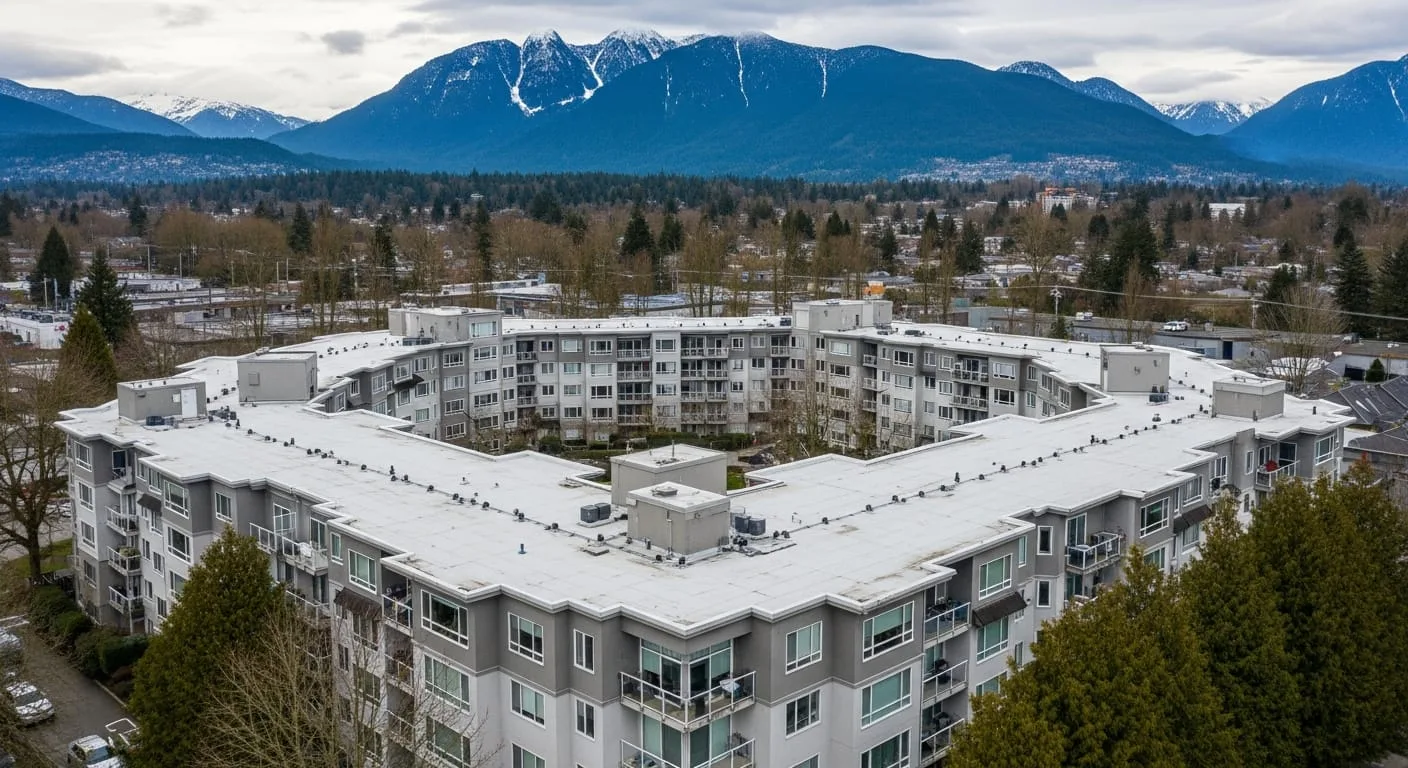
Why is everyone suddenly talking about a "25-year roof rule"?
There is no single law, regulation, or insurance code that says "25 years." What there is — and what councils are running into at every renewal cycle since the 2018–2021 hardening of the BC strata insurance market — is a convergence of underwriting practices around that number. Reinsurers pulled back from BC strata after several years of catastrophic water-damage losses, and the surviving primary insurers responded by tightening their roof-age questions on renewal applications. The age 25 threshold became a common trigger point because it lines up with the typical functional service life of the asphalt shingle, two-ply SBS, and early-generation single-ply roofs that dominate BC's 1990s and early-2000s strata stock.
In practice this means underwriters now ask three questions: (1) how old is the roof, (2) when was it last professionally inspected, and (3) is there a funded replacement plan in the depreciation report. A "yes / recent / yes" answer keeps the building in the standard market. A "25+ / unknown / no" answer pushes the building toward a sub-standard market, a high deductible, or a declination. Councils that understand this dynamic can manage it. Councils that don't tend to find out by reading a renewal letter that adds $40,000 to the operating budget.
Does my insurer actually require replacement at 25 years?
Almost never in writing. What insurers do is price and structure coverage so that operating with a 25+ year roof becomes financially unattractive for the strata corporation. The most common mechanisms are (a) a per-occurrence water-damage deductible that rises from $10,000–$25,000 to $50,000, $100,000, or even $250,000+; (b) a policy endorsement excluding "resultant damage from a pre-existing roof condition"; (c) a surcharge of 20–80% on the base premium; or (d) a refusal to quote, forcing the broker into the surplus-lines or unrated market. Any of these is a de facto replacement requirement once the council does the math against a planned reroof.
The exception is when an insurer or their loss-control engineer issues a written warranty or recommendation letter requiring action by a specific date. If your strata receives one of these, treat it as a hard deadline — failure to comply is grounds for mid-term cancellation, which is far worse than a renewal surcharge.
Where does the 25-year number come from?
It is the rough intersection of three independent timelines. First, manufacturer warranty math: a "30-year" architectural shingle in the BC coastal climate typically delivers 22–28 years of useful service before granular loss, lift, and seal-strip failure make it a leak risk. Second, RCABC RoofStar warranty terms: most two-ply SBS torch-on systems are warranted for 10 years on workmanship and 20–25 on material, after which the warranty is exhausted and the assembly is on borrowed time. Third, BC depreciation report convention: consultants writing reports under Strata Property Regulation §6.2 commonly assign a 25-year remaining life to roofs at installation and recommend reserve funding accordingly. When all three converge, year 25 becomes the natural decision point.
Our roof is 22 years old. When should we actually start the replacement conversation?
Now. The minimum realistic timeline from "council agrees to investigate" to "crew on the roof" for a typical BC strata replacement is 9–14 months, and that assumes nothing goes sideways. The sequence is roughly: condition assessment (4–6 weeks), scope definition and specification (3–4 weeks), tender to qualified contractors (4–6 weeks), council review and contractor interviews (3–4 weeks), special-levy resolution drafting and notice (minimum 2 weeks under the Strata Property Act for an SGM), AGM or SGM vote (variable), permit application (3–8 weeks depending on municipality), contractor scheduling (often 8–16 weeks lead time in peak season), and weather window. Starting at year 22 puts the actual reroof in years 23–24, which lands the building safely inside the 25-year insurance window.
Councils that wait until year 25 to begin the conversation almost always end up paying for an emergency or expedited replacement at year 27 or 28 after the insurance renewal forces the issue. Expedited reroofs cost 10–25% more than planned reroofs because they collapse competitive tendering, force off-season scheduling, and remove the ability to negotiate scope.
What does a strata roof replacement actually cost in BC right now?
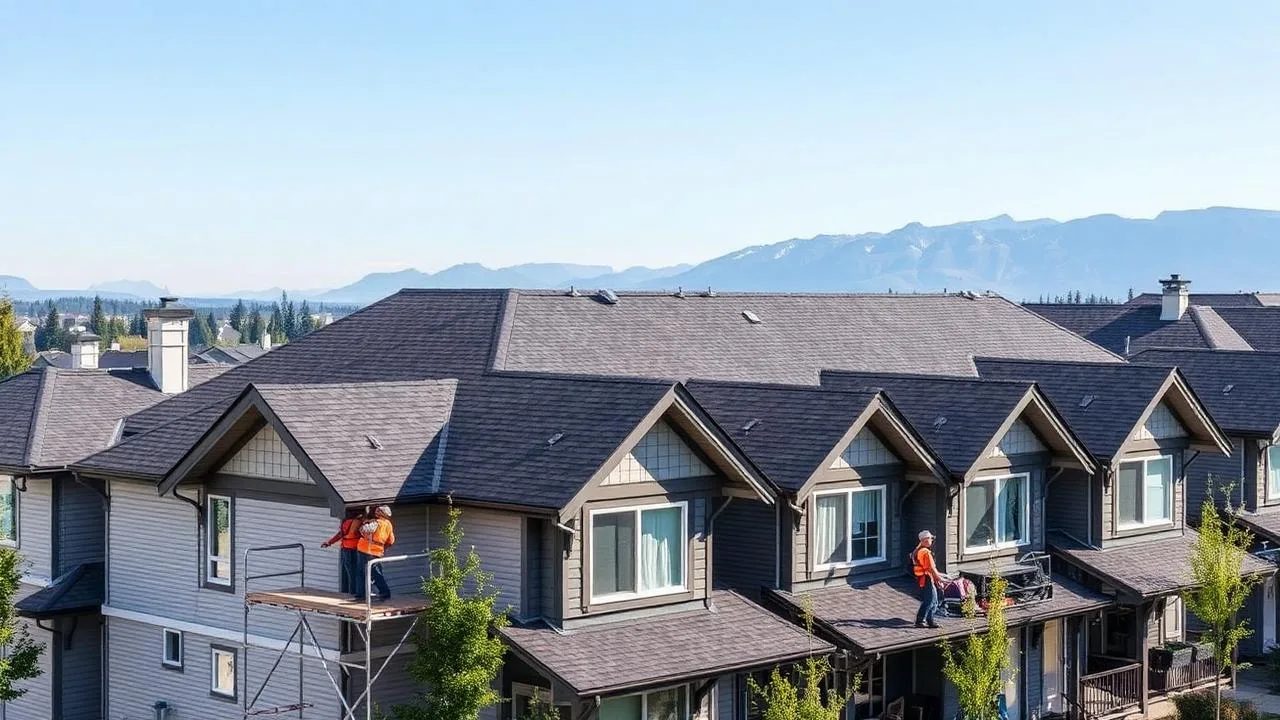
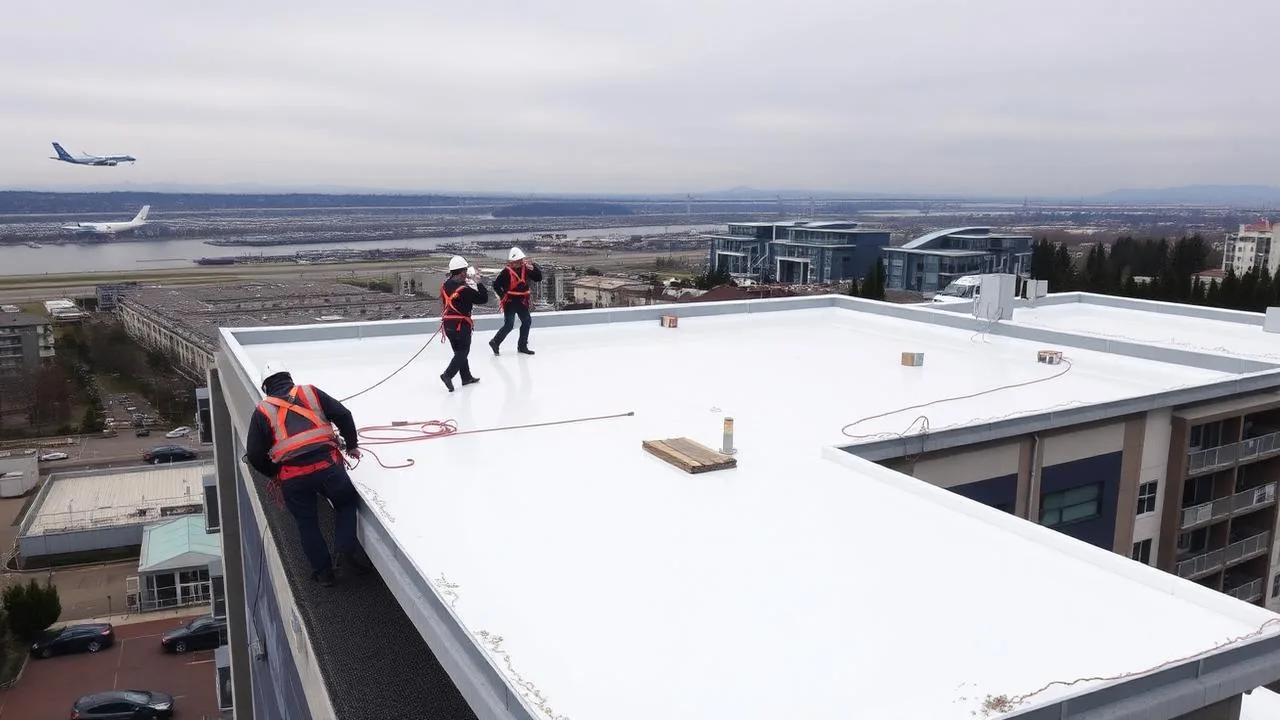
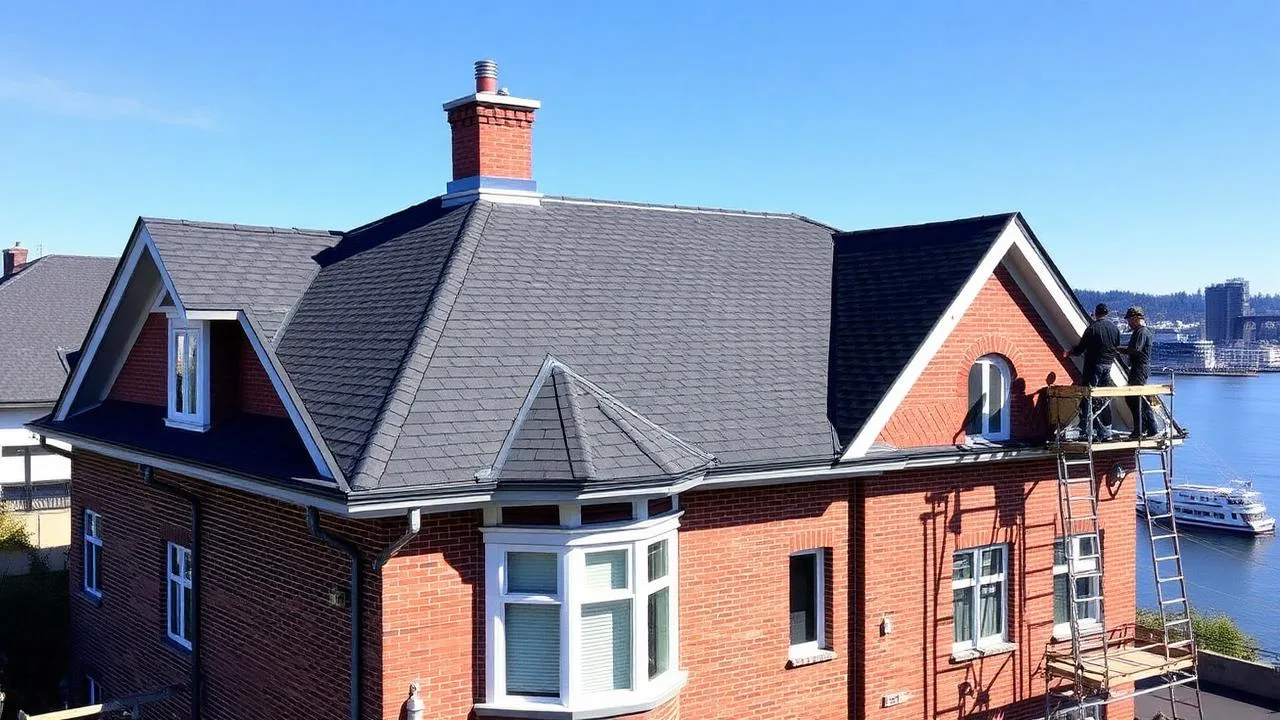
Ranges vary by assembly, access, and complexity, but typical 2026 BC numbers we see on quotes look like this. Asphalt shingle replacement on a sloped townhome complex: $7–$11 per square foot of roof area including tear-off, underlayment, ventilation upgrades, and disposal. Two-ply SBS torch-on on a flat low-rise: $14–$22 per square foot including insulation refresh, drains, and parapet flashing. TPO or PVC single-ply on a flat mid-rise: $13–$20 per square foot for a fully adhered system with tapered insulation. Cedar shake to asphalt or metal conversion: add 15–25% for tear-off and substrate repair. A 50-unit townhome complex with 38,000 sq ft of pitched roof typically lands in the $400,000–$650,000 range; a 60-unit four-storey wood-frame with a flat roof in the $550,000–$950,000 range; a high-rise podium reroof in the $1.0–$1.8 million range.
These numbers are wide on purpose — the only honest way to know your building's number is a site-specific quote. We publish typical ranges so councils can sanity-check whether their budget is in the right zip code before going to tender.
Will the depreciation report tell us the right replacement year?
Sometimes, but rarely with the precision a council needs. A depreciation report is a planning document, not a condition assessment. It typically uses age-based assumptions and visual inspection to assign a "remaining useful life" number that gets fed into the 30-year cash flow projection. What it usually does not include is a granular assessment of the actual roof assembly — moisture readings, fastener pull tests, infrared scans, drain function, parapet condition, or a layer-by-layer evaluation of where the roof sits on its functional curve.
The right approach is to use the depreciation report as the budgeting backbone and then layer a roof-specific condition assessment on top of it every 3–5 years starting at year 15. The condition assessment is what tells you whether the depreciation report's "year 27 replacement" is realistic or whether you need to pull it forward to year 23. Councils that do both consistently are the ones whose insurance applications come back clean.
What if our roof "looks fine" from the ground?
Roof condition from the ground is among the least reliable data points in strata governance. Asphalt shingles can shed granules, lose seal-strip adhesion, and develop hairline cracks for a decade before any of it is visible from the parking lot. SBS torch-on can have failed laps, ponding-water embrittlement, and granular loss on the cap sheet that only become obvious at 4-foot inspection distance. Single-ply membranes can develop seam separation, mechanical damage from foot traffic, and shrinkage at penetrations long before the first ceiling stain appears in a top-floor unit.
The first leak in a strata building is almost never the first failure — it is the first failure that has now travelled far enough through the assembly to reach an interior finish. By that point, the cost of associated water-damage repairs, drywall, insulation, and mould remediation often exceeds the cost of the roof replacement itself, and your insurance deductible just became real.
How do we coordinate with our property manager and insurance broker?
The most effective sequence we see in well-run strata corporations is this. (1) Council requests a roof condition assessment from a qualified contractor and shares the written report with the property manager. (2) Property manager forwards the condition assessment to the insurance broker before the next renewal cycle, so the broker can use it as evidence of active management when negotiating with underwriters. (3) Broker confirms in writing what the underwriter will require — typically a copy of the assessment, a funded line in the depreciation report, and a target replacement date. (4) Council aligns the special-levy resolution and AGM timing with the broker's calendar so the insurance application can reflect the funded plan, not just the existing roof age.
This sequence routinely keeps premiums flat and deductibles in the standard range even on roofs in years 22–26. Skipping any step pushes the building toward the worst-case underwriting scenario.
Can we just patch and extend the roof past 25 years?
Sometimes, but with eyes open. Strategic repair on a roof in years 20–24 — replacing failed flashings, refurbishing parapet caps, installing new drains, addressing isolated membrane damage — can extend functional life by 2–5 years and is often the right move when capital is not yet in place. What it does not do is reset the insurance clock. Underwriters ask roof age based on the original installation date, not the date of the most recent repair, unless the repair constitutes a substantial recover or full replacement of the wear surface.
Repair-and-extend is therefore a financing strategy, not an insurance strategy. It buys the council the time needed to fund the eventual replacement; it does not eliminate the replacement. Councils that conflate the two often end up funding both a major repair and a full replacement within five years of each other.
What about a "roof recover" instead of a full tear-off?
The BC Building Code allows up to two roof coverings on a structure (the original plus one recover) provided structural capacity, deck condition, and assembly compatibility are confirmed. A recover — typically a new single-ply or modified bitumen layer installed over an existing asphalt or BUR roof — costs 60–75% of a full tear-off and is often appealing on a tight budget. The catch: a recover is only viable when the existing assembly is dry, structurally sound, and free of trapped moisture. On most 25-year-old BC strata roofs, infrared scanning reveals enough wet insulation to disqualify the recover option and force a full tear-off.
The right call is to put both options on the table during the condition assessment, run the moisture survey, and let the data decide. A recover that traps wet insulation is a guaranteed warranty claim within five years.
Our reserve fund is short. What are our options?
Three, in increasing order of council pain. (1) Stagger the work across two to three fiscal years if the building has phaseable roof areas — this lets the contribution to reserve catch up without a special levy. (2) Special levy under SPA §108, which requires a 3/4 vote of owners present at an AGM or SGM and is the most common path for BC strata roof replacements. (3) External financing through a credit union or strata loan provider, repaid through a special levy spread over 5–15 years; this is increasingly common as roof replacement costs outpace reserve growth. None of these is free, but all of them are cheaper than the combined cost of an emergency replacement plus the insurance consequences of letting the roof drift past 25 years uninsured or underinsured.
How do we choose a contractor we can defend at AGM?
The defensibility test has five parts. (1) Red Seal Roofer credentials on the lead crew, verifiable through Industry Training Authority BC. (2) RCABC membership in good standing and RoofStar warranty eligibility on the proposed assembly. (3) WorkSafeBC clearance letter dated within 30 days. (4) A minimum of three reference projects from BC strata corporations of comparable size completed in the last 24 months, with permission to call council members. (5) A written scope document that names manufacturers, product SKUs, fastener patterns, insulation R-values, warranty terms, and exclusions. A contractor who cannot produce all five within 48 hours is not the right contractor for a $500,000 capital project.
This is the same evaluation matrix we apply to ourselves and the same one we encourage councils to apply to every quote — including ours. See our process page for the full council-facing engagement model and our team page for the credentials we ask councils to verify.
What does a "council-ready quote" actually include?
A quote that a council can take to a vote — not just a price on a single page — needs nine elements. (1) Scope of work in plain language, with photographs of the existing conditions. (2) Specified roofing assembly with named manufacturer and product. (3) Insulation, ventilation, drainage, and flashing details. (4) Tear-off and disposal plan. (5) Site safety and access plan, including parking impact and resident communication. (6) Schedule with weather-contingency language. (7) Warranty terms broken into workmanship and material, with copies attached. (8) Insurance certificates and WorkSafeBC clearance. (9) Payment schedule tied to milestones, never lump-sum upfront.
If your current quote is one page with a single number on it, it is a quotation, not a proposal. Send it back and ask for a council-ready version.
Get a council-ready quote today
If your roof is in years 18–28, your insurance renewal is approaching, or your depreciation report flags a roof line item in the next 0–5 years, the smart move is to start the conversation now while you still have optionality. We provide free, no-pressure condition assessments and council-ready quotes that align with your depreciation report, your insurance broker's requirements, and your AGM calendar — and we hand the documentation directly to your property manager so nothing gets lost in translation.
Get a quote today at stratapropertyservices.com →
You can also request a council-ready quote directly from this site, contact us with questions about your specific building, or read our companion guide on BC depreciation report rules in 2026 and how to present a roof replacement budget at your AGM.
Service area for this work
We deliver strata roof replacement, condition assessments, and council-ready quotes across Metro Vancouver and the Fraser Valley, including Vancouver, Burnaby, Richmond, New Westminster, and Coquitlam. Each city page includes the local building permit office, typical strata housing types, and seasonal scheduling notes that affect tendering and replacement timelines.
What documentation should we keep on file for the next 25 years?
The single biggest mistake we see councils make after a successful reroof is failing to assemble a complete documentation package and hand it to the property manager for permanent retention. The package an insurance underwriter, a future buyer's lawyer, or a Section 35 records request will eventually ask for includes the signed contract and final scope of work, the manufacturer warranty registration confirmation (this is time-sensitive — most warranties must be registered within 30–60 days of substantial completion), the RCABC RoofStar warranty certificate if applicable, the WorkSafeBC clearance letter at start and finish, the building permit and final inspection sign-off from the municipality, the contractor's certificate of insurance for the project period, all change orders and the reasons for them, before-and-after photographs of the entire roof area including penetrations and parapets, the moisture survey or infrared scan report if one was performed, and the recommended maintenance schedule with the next inspection date already booked.
This package becomes the evidentiary backbone for every future insurance renewal, every depreciation report update, and every disclosure obligation when units sell. Councils that maintain it well typically retain standard-market insurance terms throughout the life of the new roof. Councils that don't tend to find themselves recreating it under pressure during a claim or a renewal cycle.
What ongoing maintenance keeps the warranty and the insurance terms intact?
Most manufacturer and RCABC RoofStar warranties contain a maintenance clause that voids coverage if the roof is not professionally inspected at defined intervals — typically annually or semi-annually for commercial-grade assemblies. Insurance underwriters increasingly ask for proof of those inspections at renewal. The good news is that the cost of compliance is small relative to the value it protects: a typical strata maintenance inspection runs $400–$1,200 depending on building size, and the resulting written report satisfies both the warranty and the underwriting requirement in a single document.
A reasonable maintenance cadence for a BC strata roof in years 1–15 includes a spring inspection focused on winter damage, gutter and drain function, and moss treatment if applicable; a fall inspection focused on debris removal, sealant condition at penetrations, and pre-storm readiness; immediate response after any wind event over 70 km/h or hail event; and a five-year deeper assessment that includes a sample moisture survey and a written remaining-life update. Councils that follow this cadence routinely get full warranty service when issues arise and rarely see negative surprises at renewal.
What is the single most important thing to do this month?
Pull your most recent depreciation report off the shelf, find the roof line item, and write down two numbers: the original installation year of the current roof and the projected replacement year in the report. Subtract the installation year from 2026. If the answer is 18 or higher, put a roof condition assessment on the agenda for your next council meeting. If the answer is 22 or higher, request quotes this quarter. If the answer is 25 or higher and you do not yet have a funded replacement plan, treat it as the most urgent item on the council's docket — your next insurance renewal will not wait, and the cost of acting late always exceeds the cost of acting early.
None of this requires the council to commit to anything beyond gathering information. A condition assessment and a council-ready quote cost nothing and create no obligation. They simply give the council the data it needs to make a defensible decision on its own timeline, instead of an emergency decision on the insurer's timeline.